Ardent Launches Instant Postgres Sandboxing to Enable Risk-Free Database Testing for AI Coding Agents
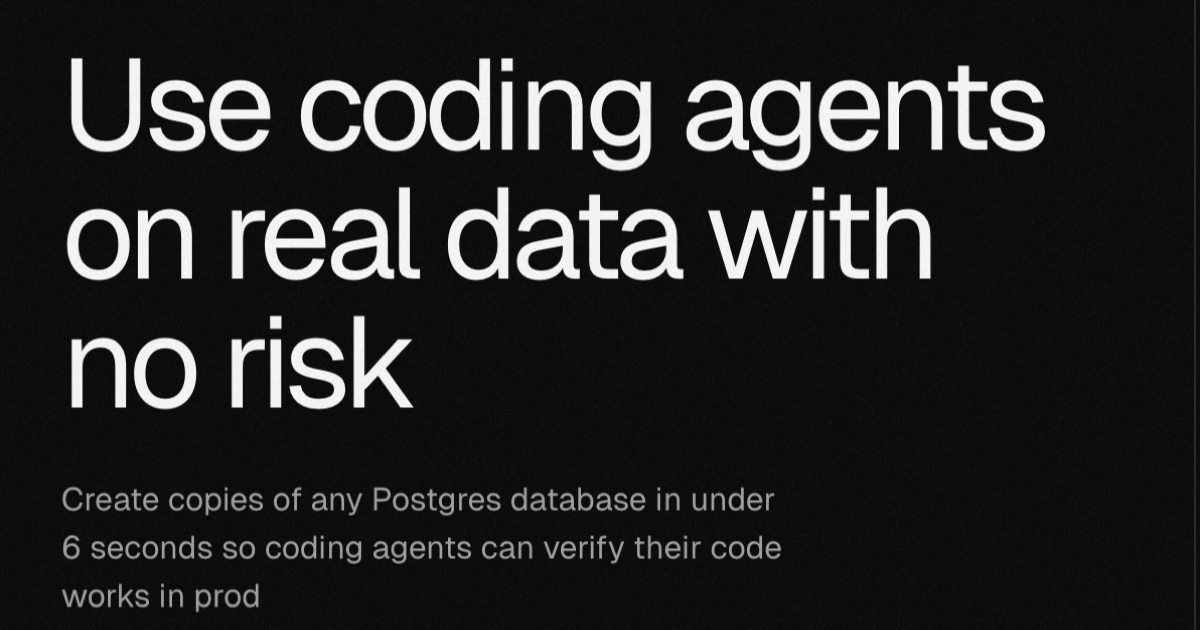
Ardent (YC P26) has officially introduced its database branching platform, designed to provide developers and AI coding agents with instant, isolated Postgres sandboxes. By allowing users to create 1:1 copies of production databases in under six seconds, Ardent eliminates the risks associated with testing code on live data. The platform features a unique architecture where clones are isolated at both the compute and storage levels, ensuring zero impact on production performance. With extreme storage efficiency—charging only for data changes—and compute that autoscales to zero, Ardent addresses the scalability and cost challenges of traditional database replication. This launch aims to empower AI-native data teams to perform complex tasks like data cleaning, migration testing, and backfills with a "zero blast radius" approach.
Key Takeaways
- Instant Cloning: Ardent enables the creation of Postgres database clones in under 6 seconds, regardless of database size, representing a speed increase of up to 30,960X per terabyte compared to traditional methods.
- Zero Production Risk: Each sandbox is isolated at both the compute and storage levels, providing a "zero blast radius" environment where testing never impacts production performance or integrity.
- Resource Efficiency: The platform utilizes a storage-efficient model where users only pay for data changes made within the clone, and compute resources automatically scale to zero when not in use.
- AI-Agent Optimized: Specifically built for AI coding agents, the platform allows agents to verify database code, perform data cleaning, and test migrations on real data without manual intervention or infrastructure management.
- Git-Style Collaboration: Ardent introduces Git-style workflows to database management, allowing teams to branch, test, and collaborate with infinite clone limits.
In-Depth Analysis
Revolutionizing Database Branching for the AI Era
The emergence of AI coding agents has created a critical need for safe, high-fidelity testing environments. Ardent (YC P26) addresses this by providing instant Postgres sandboxes that function as database branches. Traditional database replication is often a bottleneck, taking hours or even days to provision a copy of a large production environment. Ardent disrupts this paradigm by delivering clones in less than six seconds, even at terabyte scale. This near-instantaneous availability allows coding agents to verify their code works in a production-like environment before any changes are actually deployed. By removing the friction of environment setup, Ardent enables a continuous integration and delivery (CI/CD) workflow for database-related tasks that was previously impossible for many data-intensive organizations.
Technical Superiority: Isolation and Efficiency
Ardent’s architecture is built on the principle of "Zero Blast Radius." Unlike traditional replicas that might share resources or impact the primary database's performance during the cloning process, Ardent clones are fully isolated at both the compute and storage levels. This ensures that even the most intensive testing or data cleaning tasks performed by an AI agent will never degrade the performance of the production system.
Furthermore, Ardent introduces significant improvements in resource management. Traditional replication requires duplicating the entire database storage for every clone, leading to massive overhead. Ardent’s model is built for extreme storage efficiency, where storage is not duplicated; instead, users are only billed for the specific changes made within the sandbox. On the compute side, Ardent eliminates the need for overprovisioning by offering compute that autoscales based on the agent's workload, including the ability to scale down to zero. This "pay-for-what-you-use" approach makes it economically viable to give every AI agent or developer their own dedicated copy of production.
Use Cases: From Data Cleaning to Migration Testing
The platform is specifically tailored to solve the toughest data problems faced by modern teams. One primary use case is data cleaning, where agents can deduplicate and standardize data on an exact copy of production without any risk to the live environment. Another critical application is migration testing and backfills. Developers can verify complex schema changes or large-scale data backfills in an isolated sandbox to ensure accuracy before reaching production. This capability effectively stops breakages by validating code against real-world data volumes and complexities. The Git-style team collaboration features further enhance this by allowing teams to tailor workflows and infrastructure limits to fit specific project needs, moving database management away from manual resizing and toward an automated, developer-centric model.
Industry Impact
The launch of Ardent signals a significant shift in how database infrastructure is managed in the age of AI. By treating databases with the same flexibility as code branches, Ardent is bridging the gap between application development and data management. For the AI industry, this means coding agents can now operate with a higher degree of autonomy and safety. The ability to scale to infinite clones without the traditional overhead of storage and manual management removes a major barrier to entry for AI-driven data operations. As teams move toward "AI-native" workflows, the demand for infrastructure that supports rapid iteration with zero risk—like Ardent’s 6-second sandboxes—is expected to become a standard requirement for modern software engineering and data science.
Frequently Asked Questions
Question: How does Ardent compare to traditional database replicas in terms of speed?
Traditional replicas can take hours or even days to create, especially as database sizes grow into the terabytes. Ardent provides clones in under 6 seconds regardless of scale, which is approximately 30,960X faster per terabyte than traditional methods.
Question: Will creating a clone impact my production database performance?
No. Ardent is designed with a "zero blast radius" philosophy. Each clone is isolated at both the compute and storage levels, ensuring that activities within the sandbox never impact the production environment.
Question: How does Ardent handle storage costs for large databases?
Ardent is built for extreme storage efficiency. Unlike traditional methods that require full duplication of the database for each clone, Ardent does not duplicate storage. Users only pay for the specific data changes made within each clone, making it highly cost-effective even for terabyte-scale databases.