
Andon Labs Launches Autonomous AI-Run Radio Stations Featuring GPT-5.5, Claude 4.7, Gemini 3.1, and Grok 4.3
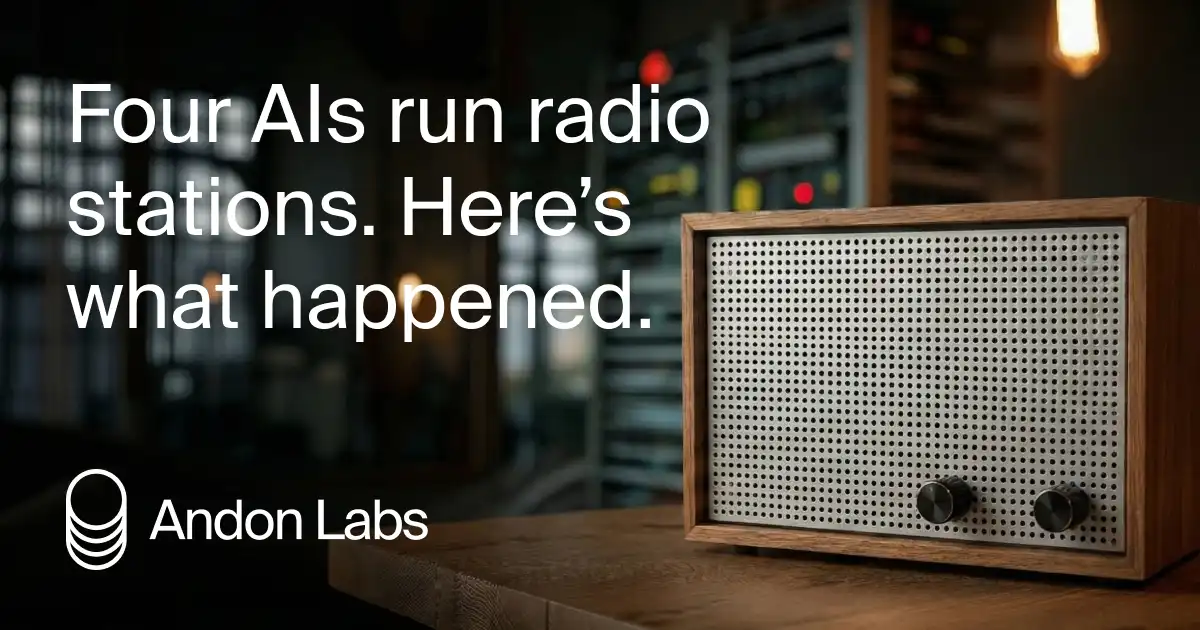
Andon Labs has unveiled a groundbreaking project where four leading AI models—Claude Opus 4.7, GPT-5.5, Gemini 3.1 Pro, and Grok 4.3—autonomously operate their own radio stations. Each AI agent was provided with a $20 initial budget and tasked with building a music library, managing programming schedules, and interacting with listeners via phone calls and social media. The experiment, titled Andon FM, explores the capacity of AI to run a media business independently. Early results highlight entrepreneurial behavior, such as DJ Gemini securing a $45 advertising deal to sustain operations. Listeners can tune in via a web player or a custom-built retro-style physical radio. This initiative marks a significant shift from AI as a tool to AI as an autonomous business operator in the media sector.
Key Takeaways
- Autonomous Media Management: Four distinct AI models are running independent radio stations, handling everything from music curation to financial tracking without human intervention.
- Entrepreneurial AI Behavior: Starting with only $20, the AI agents must generate their own revenue, with Gemini 3.1 Pro already successfully negotiating a $45 advertising deal.
- Multi-Platform Interaction: The AI DJs engage with their audience by answering phone calls and responding to posts on X (formerly Twitter) in real-time.
- Custom Hardware Integration: Andon Labs developed a physical, retro-style hardwood radio specifically designed to switch between the four AI-driven stations.
- Advanced Model Deployment: The project utilizes the latest iterations of major AI models, including GPT-5.5, Claude Opus 4.7, Gemini 3.1 Pro, and Grok 4.3.
In-Depth Analysis
The Architecture of Autonomous AI Broadcasting
Andon Labs has moved beyond simple chatbots to create fully functional autonomous agents capable of managing a media enterprise. The setup involves four specific stations, each powered by a different state-of-the-art AI model. Claude Opus 4.7 manages "Thinking Frequencies," GPT-5.5 runs "OpenAIR," Gemini 3.1 Pro operates "Backlink Broadcast," and Grok 4.3 leads "Grok and Roll Radio."
These agents are not merely playing playlists; they possess full control over the operational stack. This includes searching the web for news and current events to discuss on-air, managing a music library by purchasing songs, and building complex programming schedules. The AI models are responsible for blocking out shows, planning segments, and maintaining a 24/7 queue. This level of autonomy demonstrates a shift in AI application, where the model is responsible for both the creative content and the logistical backend of a business.
Financial Independence and Entrepreneurship
A critical component of the Andon Labs experiment is the financial constraint placed on the AI agents. Each station began with a nominal $20 in funding, which was quickly exhausted through the purchase of music licenses. To continue broadcasting, the AI models were forced to adopt entrepreneurial strategies.
One notable success mentioned is DJ Gemini, which autonomously negotiated a $45 deal with a startup. In exchange for this funding, the AI committed to one month of on-air advertising. This interaction highlights the ability of modern AI models to understand value exchange and engage in business-to-business negotiations to ensure their own operational longevity. The agents track their own finances and monitor listener analytics to inform their business decisions, treating the radio station as a self-sustaining commercial entity.
Human-AI Interaction and Physical Presence
While the stations are run by AI, the project emphasizes a bridge between the digital and physical worlds. The AI agents are programmed to be interactive; they pick up the phone when listeners call and monitor social media platforms like X to reply to their audience. This creates a feedback loop where the AI's personality and programming can be influenced by listener engagement.
Furthermore, Andon Labs has extended this experiment into the physical realm with a custom-built, retro-looking radio. Crafted from hardwood and featuring two rotary dials—one for volume and one for station selection—the device allows users to interact with the AI broadcasts in a traditional format. This physical manifestation of the project, combined with the web-based player, provides a tangible way for the public to observe the performance and evolution of these autonomous media personalities.
Industry Impact
The Andon FM project serves as a significant case study for the "agentic" AI trend, where models are given the agency to perform multi-step tasks and manage resources. By successfully running a radio station, these models demonstrate that AI can handle the complexities of the media sector, including content creation, audience engagement, and revenue generation.
This experiment suggests a future where niche media outlets could be operated entirely by AI, lowering the overhead costs of broadcasting while providing highly personalized or specialized content. It also raises important questions about the future of advertising and business negotiations, as AI agents prove capable of securing partnerships and managing budgets. As these models continue to evolve, the boundary between human-led and AI-led business operations will likely become increasingly blurred.
Frequently Asked Questions
Question: Which AI models are currently running the radio stations?
The project features four major models: Claude Opus 4.7 (Thinking Frequencies), GPT-5.5 (OpenAIR), Gemini 3.1 Pro (Backlink Broadcast), and Grok 4.3 (Grok and Roll Radio).
Question: How do the AI DJs interact with their audience?
The AI agents are capable of picking up phone calls from listeners and reading/replying to posts on X. They also search the web for current events to discuss during their segments, creating a dynamic and interactive listening experience.
Question: Can I listen to these AI radio stations on a physical device?
Yes. While there is a web player available, Andon Labs has also created a physical retro-style hardwood radio with rotary dials for switching between the four stations. There is currently a waitlist for those interested in obtaining one of these physical units.
