
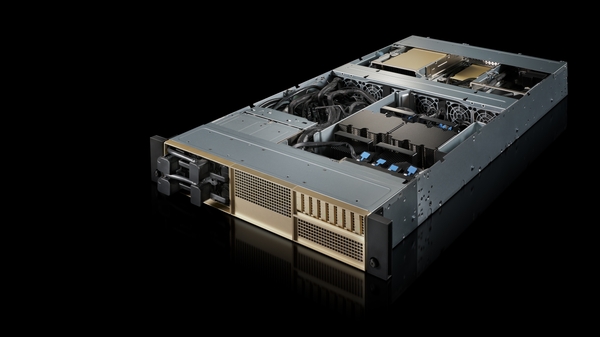
NVIDIA Vera CPU Benchmarks Reveal High Performance for Agentic AI and AI Factory Requirements
NVIDIA has announced that its Vera CPU is specifically engineered to meet the evolving demands of agentic AI within the modern AI factory. According to initial benchmark results published by Phoronix, the Vera CPU addresses critical hardware requirements, including the need for fast cores and massive memory bandwidth. The processor is designed to maintain high performance levels even when all cores are active, a necessity for the complex, sustained workloads associated with autonomous AI agents. This first public look at the Vera CPU's performance highlights its competitive positioning in the hardware market, focusing on the infrastructure needed to support the shift toward more sophisticated AI systems that require robust, high-bandwidth processing power.
Key Takeaways
- Agentic AI Demands: The shift toward agentic AI has introduced new hardware requirements, specifically necessitating CPUs with fast cores and massive memory bandwidth.
- Sustained Performance: The NVIDIA Vera CPU is designed to maintain high performance levels even under full load when all cores are active.
- Benchmark Validation: Initial public benchmark results from Phoronix confirm that the Vera CPU meets the rigorous performance needs of the AI factory.
- Infrastructure Focus: The Vera CPU is positioned as a critical component for the 'AI factory,' where high-speed processing and data throughput are essential.
In-Depth Analysis
Addressing the New Requirements of Agentic AI
As the industry transitions toward agentic AI, the underlying hardware infrastructure must evolve to handle increasingly complex tasks. According to NVIDIA, this shift creates a specific set of CPU requirements that traditional processors may struggle to meet. The primary needs identified for the AI factory include fast cores and massive memory bandwidth. Agentic AI refers to systems that can act autonomously to achieve goals, which often requires rapid data processing and the ability to handle multiple concurrent streams of information.
The NVIDIA Vera CPU has been developed to address these exact bottlenecks. By focusing on core speed and the volume of data that can be moved through the system (bandwidth), the Vera CPU ensures that AI agents can operate without being throttled by hardware limitations. The emphasis on 'massive memory bandwidth' suggests that the Vera CPU is optimized for data-intensive environments where the speed of information retrieval is just as important as the speed of the calculation itself.
Sustained Performance in the AI Factory Environment
One of the most significant challenges in high-performance computing is maintaining peak performance when the system is under maximum stress. NVIDIA highlights that the Vera CPU is built with the ability to sustain high performance even when all cores are active. In many standard CPU architectures, performance can degrade as heat increases or as the system struggles to manage the power distribution across all active cores. However, for the 'AI factory'—a term used to describe large-scale AI production environments—consistency is vital.
The initial benchmark results published by Phoronix provide the first public look at how the Vera CPU handles these demands. These benchmarks are crucial because they validate NVIDIA's claims regarding the processor's ability to handle the heavy-hitting requirements of modern AI. By proving that the Vera CPU can maintain its 'punch' against competition while all cores are engaged, NVIDIA demonstrates that the hardware is capable of supporting the non-stop, high-intensity workloads required by autonomous AI agents and large-scale AI deployments.
The Role of Fast Cores and Bandwidth
The combination of fast cores and high bandwidth is what sets the Vera CPU apart in the current competitive landscape. Fast cores allow for the quick execution of individual tasks, which is essential for the low-latency responses required by agentic systems. Meanwhile, the massive memory bandwidth ensures that these cores are never 'starved' for data. In an AI factory setting, where vast amounts of data are processed to train or run models, the synergy between core speed and data throughput determines the overall efficiency of the system. The Vera CPU’s design acknowledges that the future of AI is not just about raw power, but about the balance of speed and the ability to move data efficiently across the architecture.
Industry Impact
The introduction and successful benchmarking of the NVIDIA Vera CPU signal a significant shift in how hardware is designed for the AI era. By specifically targeting the needs of 'agentic AI,' NVIDIA is moving beyond general-purpose computing toward highly specialized infrastructure. This has several implications for the industry:
- Setting New Standards for AI Infrastructure: The Vera CPU establishes a benchmark for what an 'AI factory' processor should look like, focusing on sustained multi-core performance and bandwidth rather than just peak burst speeds.
- Competitive Pressure: By delivering a 'heavy-hitting punch' against the competition, as evidenced by the Phoronix benchmarks, NVIDIA is forcing other hardware manufacturers to prioritize memory bandwidth and sustained load performance in their own enterprise CPU roadmaps.
- Enabling Autonomous Systems: The hardware capabilities of the Vera CPU provide the necessary foundation for developers to build more complex and reliable agentic AI systems, knowing that the underlying CPU can handle the sustained computational load.
Frequently Asked Questions
Question: What are the primary hardware requirements for agentic AI according to NVIDIA?
According to NVIDIA, agentic AI requires CPUs that offer fast cores, massive memory bandwidth, and the specific ability to sustain high performance levels even when all processor cores are active simultaneously.
Question: Who conducted the initial benchmarks for the NVIDIA Vera CPU?
The initial benchmark results for the Vera CPU were published by Phoronix, providing the first public look at the processor's performance capabilities in relation to AI factory needs.
Question: What is an 'AI factory' in the context of the Vera CPU?
An AI factory refers to the large-scale infrastructure and computational environments where AI models are developed, trained, and deployed. The Vera CPU is designed to serve as a high-performance core component of these factories, handling the massive data and processing demands of modern AI workloads.
