Google DeepMind Launches Gemma 4 12B: A Unified Encoder-Free Multimodal Model for Laptops
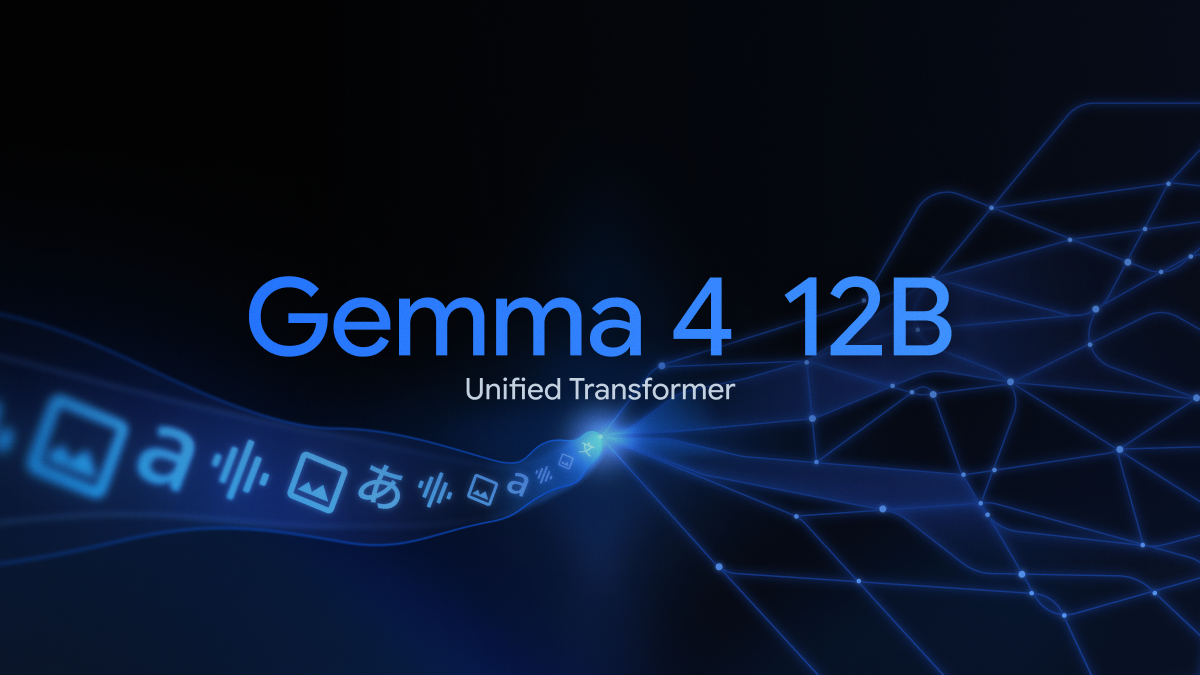
Google DeepMind has officially introduced Gemma 4 12B, a mid-sized multimodal model designed to deliver high-performance intelligence directly to local hardware. This new model features a novel unified architecture that eliminates separate multimodal encoders, allowing vision and audio inputs to flow directly into the LLM backbone. Positioned between the edge-focused E4B and the 26B Mixture of Experts (MoE) model, Gemma 4 12B is optimized for laptops with 16GB of memory. It is the first mid-sized model in the Gemma family to support native audio inputs and includes Multi-Token Prediction (MTP) drafters to reduce latency. Released under an Apache 2.0 license, it aims to empower developers to build agentic workflows and advanced AI applications on everyday devices.
Key Takeaways
- Unified Architecture: Gemma 4 12B utilizes a novel encoder-free design where vision and audio inputs flow directly into the LLM backbone.
- Native Audio Support: This is the first mid-sized model in the Gemma lineup to feature native audio input capabilities.
- Optimized for Local Hardware: The model is designed to run on laptops with as little as 16GB of VRAM or unified memory.
- High Performance: Despite its size, the 12B model offers reasoning capabilities that approach the performance of the larger 26B Mixture of Experts (MoE) model.
- Open Accessibility: Released under the Apache 2.0 license, ensuring broad availability for the developer community.
In-Depth Analysis
A New Paradigm in Multimodal Architecture
Google DeepMind's release of Gemma 4 12B marks a significant shift in how multimodal models are structured. Traditionally, multimodal AI relies on separate encoders to process different types of data—such as images or audio—before feeding that information into a large language model (LLM). Gemma 4 12B departs from this convention by employing a unified, encoder-free architecture. In this setup, vision and audio inputs are integrated directly into the LLM backbone.
This architectural choice is designed to streamline the processing of diverse data types, potentially reducing the complexity of the model while maintaining high levels of intelligence. By allowing different modalities to flow into a single backbone, the model can more effectively bridge the gap between text, sight, and sound. This integration is particularly evident in the model's support for native audio inputs, a first for a model of this specific size class within the Gemma ecosystem.
Balancing Power and Portability for Developers
The Gemma 4 12B model is strategically positioned within Google's AI portfolio. It serves as a middle ground between the E4B model, which is optimized for edge devices, and the more computationally intensive 26B Mixture of Experts (MoE) model. The primary goal of the 12B variant is to bring "agentic multimodal intelligence" to standard consumer hardware, specifically laptops.
To achieve this, the model has been engineered with a reduced memory footprint, making it compatible with systems featuring 16GB of VRAM or unified memory. This accessibility is a critical factor for developers who wish to build and test advanced AI applications locally without requiring enterprise-grade server hardware. Furthermore, to address the common issue of latency in local AI execution, Gemma 4 12B comes equipped with Multi-Token Prediction (MTP) drafters. These drafters are specifically designed to speed up the model's output, ensuring that the user experience remains fluid even when running complex multi-step reasoning tasks or agentic workflows.
Community Impact and Open Source Commitment
The launch of Gemma 4 12B comes at a time when the Gemma community is seeing rapid growth, with over 150 million downloads recorded across the model family. Developers have already utilized previous Gemma iterations to create a wide array of innovations, ranging from wearable robotic assistance to enterprise-level security tools. By releasing Gemma 4 12B under the Apache 2.0 license, Google DeepMind continues its commitment to open and accessible AI.
This licensing choice allows for broad commercial and experimental use, encouraging the developer ecosystem to integrate these advanced multimodal capabilities into new products. The combination of advanced reasoning—which Google claims nears the performance of their 26B model—and the ease of local deployment suggests that Gemma 4 12B will be a foundational tool for the next generation of AI-driven software and hardware integrations.
Industry Impact
The introduction of Gemma 4 12B is significant for the AI industry as it demonstrates the feasibility of high-performance, unified multimodal models on consumer-grade hardware. By removing the need for separate encoders, Google is simplifying the deployment of multimodal AI, which could lead to more efficient and responsive applications.
Furthermore, the focus on "agentic" capabilities—AI that can perform multi-step tasks and reason through complex workflows—suggests a shift toward more autonomous and capable local AI assistants. As more power is moved from the cloud to the "edge" (laptops and local devices), the industry may see a surge in privacy-focused, low-latency AI solutions that do not rely on constant internet connectivity or expensive cloud infrastructure.
Frequently Asked Questions
Question: What does "encoder-free" mean for Gemma 4 12B?
In traditional multimodal models, separate components (encoders) are used to translate images or audio into a format the language model can understand. In Gemma 4 12B, these inputs flow directly into the main LLM backbone, simplifying the architecture and streamlining data processing.
Question: What are the hardware requirements to run Gemma 4 12B locally?
Gemma 4 12B is designed to be "laptop ready." It requires approximately 16GB of VRAM or unified memory to run effectively, making it accessible to many modern professional and high-end consumer laptops.
Question: How does Gemma 4 12B compare to the 26B MoE model?
While Gemma 4 12B is smaller and has a reduced memory footprint, Google DeepMind states that its benchmark performance and reasoning capabilities are nearing those of the more advanced 26B Mixture of Experts (MoE) model, allowing for powerful agentic workflows on smaller hardware.