
Meituan Open-Sources LongCat-Next: Advancing Physical World AI Through Native Multimodal Vision and Speech
Meituan's technical team has announced the official release and open-sourcing of LongCat-Next, a native multimodal model designed to bridge the gap between artificial intelligence and the physical world. By treating vision and speech as "native languages," the model aims to enhance how AI perceives, understands, and interacts with real-world environments. The release includes the core LongCat-Next model and its discrete tokenizer, providing the developer community with the essential tools to build more sophisticated, world-aware applications. This move signifies a strategic step toward embodied intelligence and highlights Meituan's commitment to open-source collaboration in the field of multimodal AI development.
Key Takeaways
- Open-Source Release: Meituan has open-sourced the LongCat-Next model and its core discrete tokenizer to the global developer community.
- Native Multimodality: The model is designed with vision and speech as its "native languages," moving away from traditional text-centric AI architectures.
- Physical World Focus: The project serves as an exploration into "Physical World AI," focusing on the ability to perceive and act in real-world environments.
- Developer Empowerment: The goal of the release is to enable developers to build AI systems that can truly understand and function within the physical world.
In-Depth Analysis
Transitioning to Physical World AI
The introduction of LongCat-Next represents a strategic shift in AI development toward what Meituan terms "Physical World AI." According to the technical team, this model is an exploration into how artificial intelligence can move beyond digital constraints to interact meaningfully with the real world. The emphasis is placed on creating a system that does not merely process static data but is capable of a three-step process: perceiving, understanding, and acting.
In the context of the physical world, perception involves the real-time processing of visual and auditory signals. Understanding requires the model to contextualize these signals within a physical framework, and acting implies the potential for the AI to influence or operate within that environment. By focusing on these three pillars, LongCat-Next aims to provide a foundation for embodied intelligence, where AI is integrated into physical systems that require high levels of environmental awareness.
Vision and Speech as Native Languages
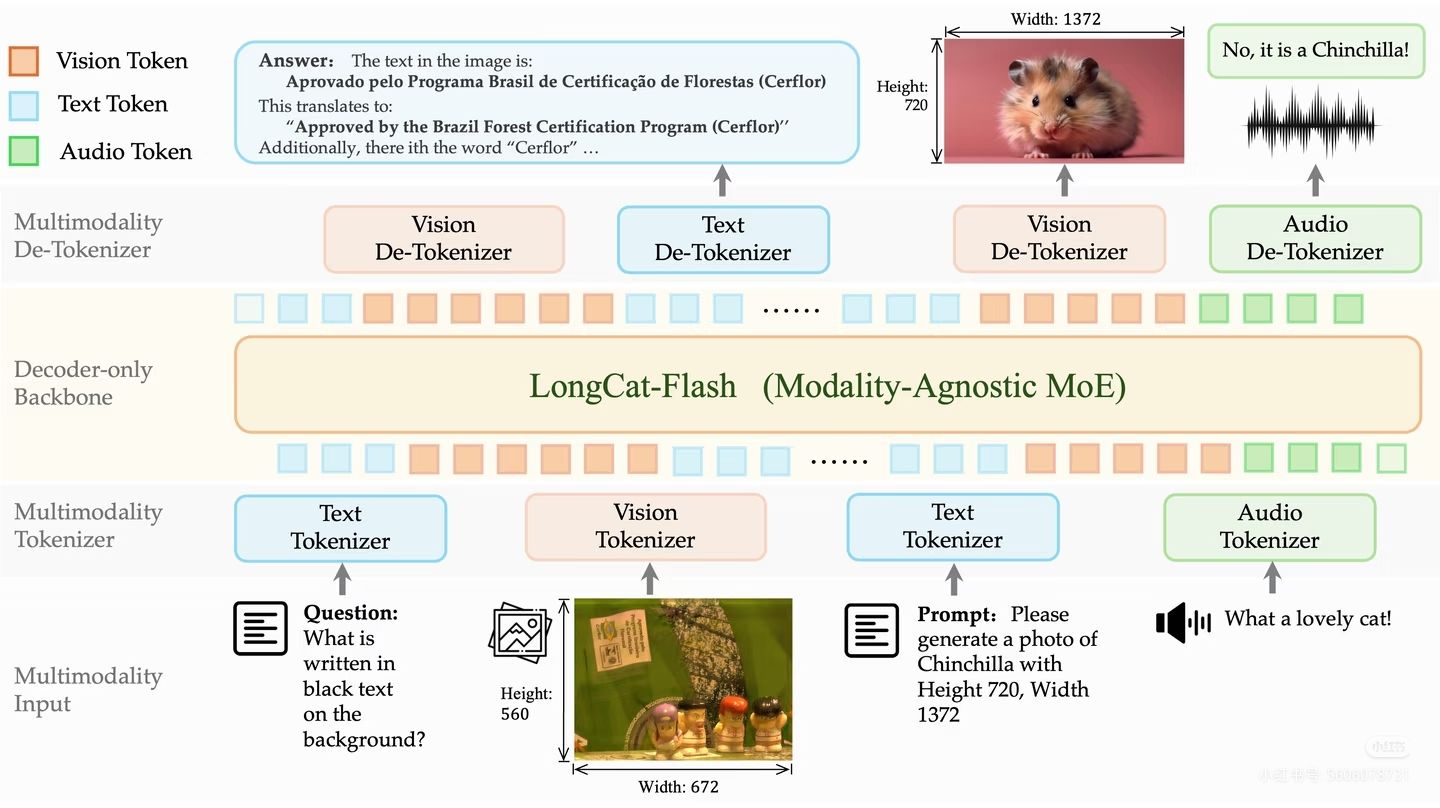
A defining characteristic of the LongCat-Next architecture is its approach to multimodality. The project title suggests a paradigm shift where vision and speech are treated as the "native languages" of the AI. In many traditional AI systems, multimodal capabilities are achieved through the use of separate modules or adapters that translate visual or audio data into a format the primary text-based model can understand.
However, a "native" multimodal approach implies a more integrated and holistic architecture. By open-sourcing the discrete tokenizer alongside the model, Meituan provides the fundamental tools necessary for converting complex visual and auditory signals into discrete units that the model can process natively. This integration is designed to reduce information loss and improve the AI's ability to interpret complex, multi-sensory environments, making it more effective for tasks that require simultaneous visual and auditory comprehension.
The Open-Source Strategy for AI Development
By choosing to open-source the core research ideas, including the LongCat-Next model and its discrete tokenizer, Meituan is positioning itself as a key contributor to the broader AI development ecosystem. The team explicitly stated their hope that more developers will build upon this foundation to create AI that can function in the real world.
This open-source strategy is significant for several reasons. First, it allows the global research community to scrutinize and improve the underlying "research ideas" that Meituan has developed. Second, it lowers the barrier to entry for developers who are interested in physical-world AI but may lack the resources to develop a native multimodal tokenizer from scratch. By providing these core components, Meituan is fostering an environment where innovation in perception and real-world interaction can be accelerated through collective effort.
Industry Impact
The release of LongCat-Next highlights the growing importance of multimodal capabilities in the AI industry. As the field moves toward more practical applications in logistics, robotics, and automated services, the ability to process vision and speech natively becomes a critical technical advantage. Meituan’s decision to open-source these components could influence the industry standard for how physical-world AI is developed, shifting the focus from purely digital large language models to systems that are inherently designed for environmental interaction. This contribution strengthens the open-source ecosystem and provides a new benchmark for native multimodal integration.
Frequently Asked Questions
What specific components of LongCat-Next have been open-sourced?
Meituan has open-sourced the core LongCat-Next model and its discrete tokenizer. These are described as the central elements of their research into physical-world AI.
What does "Native Multimodal" mean in the context of LongCat-Next?
It refers to an architecture where vision and speech are treated as primary, native inputs rather than secondary data types that need to be adapted for a text-based model. This allows the AI to process visual and auditory information more directly.
What is the ultimate goal of the LongCat-Next project?
The primary goal is to explore the path toward AI that can perceive, understand, and act within the physical world, providing a foundation for developers to build real-world AI applications.