
Managing AI Coding Through Agent Evaluation: A Case Study of Refactoring 310,000 Lines of Code
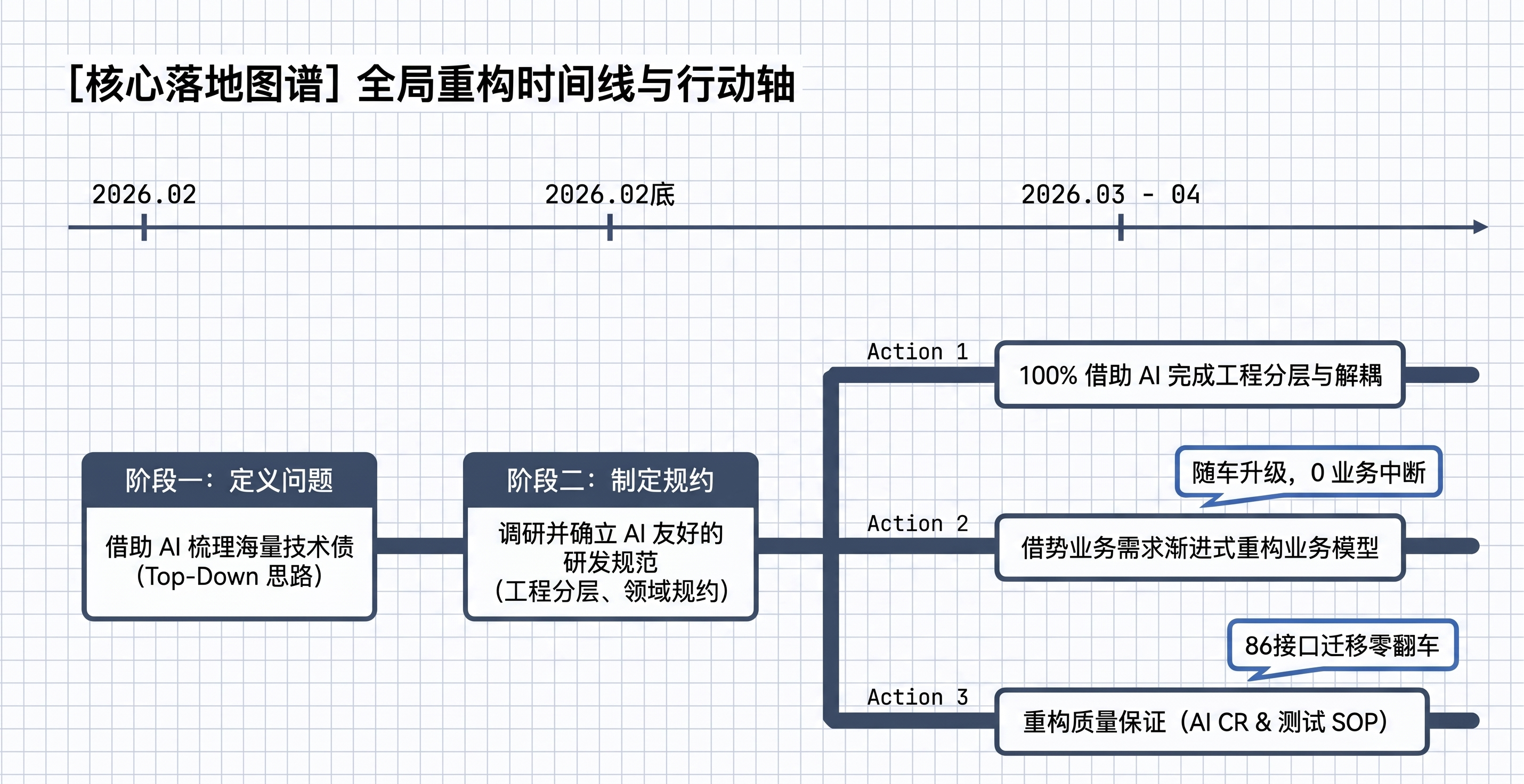
The Meituan technical team has shared a comprehensive framework for managing AI-driven development, centered on the successful refactoring of 310,000 lines of code. As AI begins to generate over 90% of codebases, the team argues that the bottleneck has shifted from coding speed to the implementation of effective constraints. Without standardized management, AI risks magnifying system complexity and chaos. The team's approach utilizes 'Agent evaluation thinking' to transform refactoring from a high-cost, specialized project into a continuous daily activity. This is achieved through four key pillars: technical debt assessment, rule construction, standardized operating procedures (SOPs), and a Pre-PR (Pull Request) mechanism. This methodology ensures that AI-generated code remains aligned with system architecture and quality standards, providing a blueprint for sustainable AI-assisted software engineering.
Key Takeaways
- Constraint Over Speed: When AI generates more than 90% of code, the primary challenge is no longer how fast code is written, but how effectively the AI is constrained by system rules.
- Agent Evaluation Logic: Managing AI coding requires a shift toward 'Agent evaluation thinking,' focusing on the quality and compliance of the AI's output rather than just the generation process.
- Four-Pillar Framework: Successful large-scale refactoring relies on technical debt sorting, rule construction, refactoring SOPs, and a Pre-PR mechanism.
- Continuous Integration: By standardizing the process, refactoring evolves from a costly, one-time specialized task into a sustainable part of the daily development iteration.
In-Depth Analysis
The Shift from Generation to Constraint Management
In the era of AI-assisted programming, the industry is witnessing a fundamental shift in the software development lifecycle. The Meituan technical team highlights a critical observation: as AI becomes responsible for the vast majority of code generation—exceeding 90% in this practice—the traditional metrics of developer productivity, such as coding speed, become secondary. The core issue identified is that AI, if left unguided, tends to amplify existing system chaos and technical debt.
To combat this, the focus must move toward 'constraints.' The 'Agent evaluation' mindset treats the AI as an autonomous agent whose outputs must be rigorously managed and verified against a set of predefined standards. This approach recognizes that the speed of AI can be a double-edged sword; while it accelerates feature delivery, it can also accelerate the accumulation of technical debt if there is no unified normative framework. Therefore, the management of AI coding is less about the act of writing and more about the architecture of the constraints that govern the AI's behavior.
Structural Mechanisms for Sustainable Refactoring
The refactoring of 310,000 lines of code serves as a massive stress test for AI management strategies. The Meituan team implemented a structured approach to ensure that this volume of change did not compromise system stability. This framework is built on four essential components:
- Technical Debt Sorting: Before AI can effectively refactor, the existing 'debt' or suboptimal code must be identified and categorized. This provides a roadmap for the AI to follow, ensuring that the most critical issues are addressed first.
- Rule Construction: AI requires clear, programmable rules to function within the desired architectural boundaries. By building these rules, the team creates a 'sandbox' for the AI, ensuring that generated code adheres to specific coding standards and design patterns.
- Refactoring SOP (Standard Operating Procedure): To move away from high-cost, one-off refactoring projects, a standardized process is necessary. This SOP allows refactoring to be integrated into the regular development flow, making it a predictable and repeatable action.
- Pre-PR Mechanism: The Pre-PR (Pull Request) stage acts as a final gatekeeper. By implementing automated checks and evaluations before code is even submitted for human review, the team ensures that only code meeting the established constraints enters the codebase. This mechanism is vital for maintaining high standards in an environment where the volume of code produced by AI would otherwise overwhelm human reviewers.
Industry Impact
The methodology shared by Meituan has significant implications for the broader AI and software development industries. As organizations increasingly adopt AI coding assistants, the 'Meituan model' suggests that the role of the human developer is evolving from a 'writer' to a 'system architect and evaluator.'
This shift highlights the necessity for new tools and platforms that focus on AI governance and quality assurance rather than just code completion. Furthermore, the successful integration of refactoring into daily iterations suggests a future where software systems are 'self-healing' or 'self-optimizing' through continuous AI-driven maintenance. For the AI industry, this emphasizes the need for Agents that are not only capable of generating code but are also 'context-aware' and 'rule-compliant,' capable of operating within the complex constraints of enterprise-level systems.
Frequently Asked Questions
Question: Why is 'Agent evaluation thinking' necessary for AI coding?
As AI generates the majority of code, the risk of inconsistent styles and architectural drift increases. Agent evaluation thinking treats AI as an entity that requires constant verification against system rules, ensuring that the speed of AI does not result in unmanageable technical debt.
Question: How does the Pre-PR mechanism improve the refactoring process?
The Pre-PR mechanism serves as an automated quality gate. It evaluates AI-generated refactoring work against established rules and standards before it reaches the human review stage. This reduces the burden on human developers and ensures that only high-quality, compliant code is integrated into the main branch.
Question: Can this approach be applied to smaller codebases?
While the practice was demonstrated on 310,000 lines of code, the principles of technical debt sorting, rule construction, and SOPs are scalable. Implementing these constraints early in a project's lifecycle can prevent the accumulation of debt, regardless of the codebase size.
