
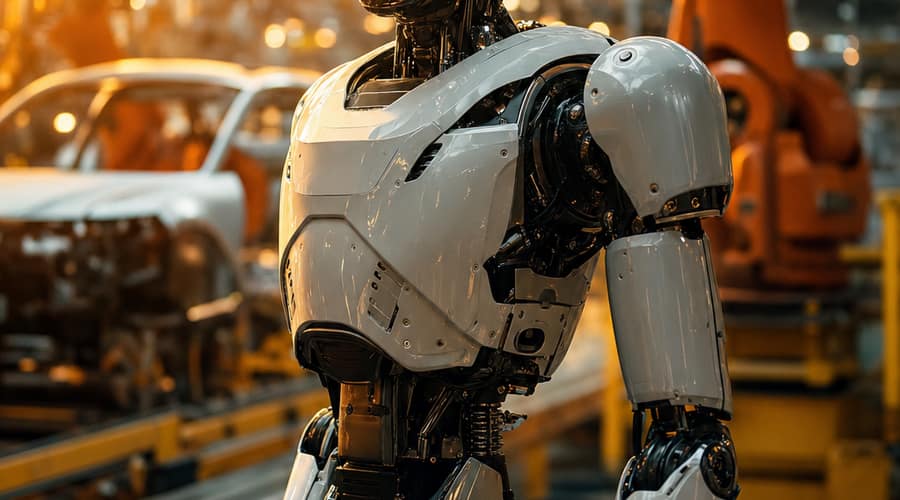
Hyundai Acquires Full Control of Boston Dynamics as SoftBank Exits in $325 Million Stake Buyout
Hyundai Motor Group is set to finalize its acquisition of SoftBank's remaining 9.65% stake in Boston Dynamics for $325 million. This strategic move, expected to receive formal approval on June 22, 2026, transitions the Waltham-based robotics pioneer into a wholly owned subsidiary of Hyundai. The transaction follows a put option established during Hyundai's initial 2021 purchase and marks the end of SoftBank's involvement. The acquisition signals a pivot from experimental research to industrial application, highlighted by the recent public demonstration of the electric Atlas humanoid robot at CES 2026. Hyundai plans to deploy production versions of Atlas at its electric vehicle manufacturing facility in Georgia by 2028, focusing on rapid task adaptation and real-world factory utility.
Key Takeaways
- Full Ownership Achieved: Hyundai Motor Group is acquiring the final 9.65% stake in Boston Dynamics from SoftBank for $325 million, gaining 100% control of the company.
- Valuation Growth: The current deal terms reflect a significant valuation increase compared to the 2021 transaction where Hyundai paid $880 million for an 80% stake.
- Industrial Pivot: The acquisition marks a shift from Boston Dynamics being a research-heavy entity to a commercially focused industrial robotics provider for Hyundai’s manufacturing plants.
- Atlas Deployment Roadmap: An electric version of the Atlas humanoid robot is scheduled for deployment at Hyundai’s Savannah, Georgia EV plant by 2028.
- Operational Efficiency: Future goals for the Atlas robot include the ability to learn and master new factory tasks within a single day or two.
In-Depth Analysis
The Strategic Consolidation of Robotics Leadership
Hyundai’s decision to exercise the final buyout of SoftBank’s remaining stake is a definitive signal of the company's long-term commitment to humanoid robotics. By paying $325 million for the remaining 9.65%, Hyundai is not merely performing a "cleanup" of an old financial arrangement; it is securing total governance over a critical technological asset. This move concludes a complex ownership journey for Boston Dynamics, which has seen the company pass from Google (acquired in 2013) to SoftBank (acquired in 2017) and finally to Hyundai (majority control in 2021).
The financial trajectory of these deals highlights the growing perceived value of the company. In 2021, the $880 million paid for 80% valued the company at approximately $1.1 billion. The current price for the remaining minority stake suggests a much higher valuation, reflecting the progress made in transitioning from viral YouTube demonstrations to tangible commercial products. With the expected approval on June 22, 2026, Boston Dynamics will officially become a wholly owned Hyundai business, allowing for deeper integration into the parent company's global manufacturing strategy.
From Viral Demonstrations to Factory Integration
For years, Boston Dynamics was characterized by its high-profile videos of robots performing parkour or dancing—content that garnered millions of views but lacked an immediate commercial application. This narrative began to change with the success of Spot, the four-legged robot, which became the company's first clear commercial hit. However, the humanoid Atlas represents a much more significant challenge and opportunity. Unlike specialized automation, humanoid robots must prove their worth in environments designed for human workers.
The public demonstration of the electric Atlas at CES in Las Vegas on January 5, 2026, served as a turning point. Unlike previous iterations, this life-sized robot was shown walking and standing in a public setting, albeit remotely piloted for the demonstration. The true significance of the CES appearance was the announcement of the deployment plan. Hyundai intends to move Atlas from the stage to the production line, specifically at its electric vehicle plant near Savannah, Georgia. This facility is expected to serve as the proving ground for Atlas in 2028, where the robot will be tasked with justifying its presence alongside traditional automation systems.
The Challenge of Rapid Task Adaptation
One of the most critical hurdles for humanoid robots in a factory setting is the speed of deployment and training. Boston Dynamics CEO Robert Playter has identified a specific benchmark for success: the ability for Atlas to learn new factory tasks in just a day or two. In traditional manufacturing, automation is often rigid and requires extensive reprogramming for any change in the production line. For a humanoid robot to be viable, it must offer flexibility that rivals or exceeds human adaptability.
Hyundai’s full control over Boston Dynamics will likely accelerate the development of the software and AI necessary to meet these learning requirements. The goal is to move beyond the "stagecraft" of pre-programmed movements toward a production version of Atlas that can handle the dynamic and varied tasks of an EV manufacturing plant. By integrating the robotics lab directly into its industrial ecosystem, Hyundai is positioning itself to lead the next wave of factory automation, where humanoid robots are no longer experimental curiosities but essential components of the workforce.
Industry Impact
Accelerating the Commercialization of Humanoid Robotics
Hyundai's full acquisition of Boston Dynamics represents a major milestone for the robotics industry. It marks the transition of humanoid technology from the "research and development" phase into the "industrial deployment" phase. By setting a clear deadline of 2028 for factory work, Hyundai is providing a concrete timeline that the rest of the industry will likely use as a benchmark. This move validates the humanoid form factor as a viable solution for complex manufacturing environments, potentially triggering increased investment and competition in the sector.
Synergy Between EV Manufacturing and Advanced Robotics
The integration of Atlas into the Savannah, Georgia EV plant highlights a growing trend of synergy between the automotive and robotics industries. As EV production requires new manufacturing processes and higher levels of precision, the flexibility of humanoid robots becomes increasingly attractive. Hyundai’s total control over Boston Dynamics allows for a bespoke development process where the robots are designed specifically to solve the unique challenges of EV assembly, potentially leading to higher efficiency and lower long-term operational costs in the automotive sector.
Frequently Asked Questions
Question: Why did Hyundai buy the remaining stake from SoftBank now?
According to the deal terms, the purchase follows a put option that SoftBank retained when Hyundai originally bought majority control in 2021. This move gives Hyundai 100% control and full governance over Boston Dynamics as it moves toward commercial deployment.
Question: When and where will the Atlas robot be deployed for work?
A production version of the electric Atlas humanoid robot is expected to begin working at Hyundai's electric vehicle manufacturing plant near Savannah, Georgia, by the year 2028.
Question: What is the main technical goal for Atlas in a factory setting?
Boston Dynamics CEO Robert Playter has stated that a key requirement for Atlas is the ability to learn and adapt to new factory tasks within a very short timeframe, specifically within one or two days, to ensure it is commercially viable compared to traditional automation.
