LARYBench Released: Defining the ImageNet for Embodied Action Representation and Measuring Generalization from Human Videos
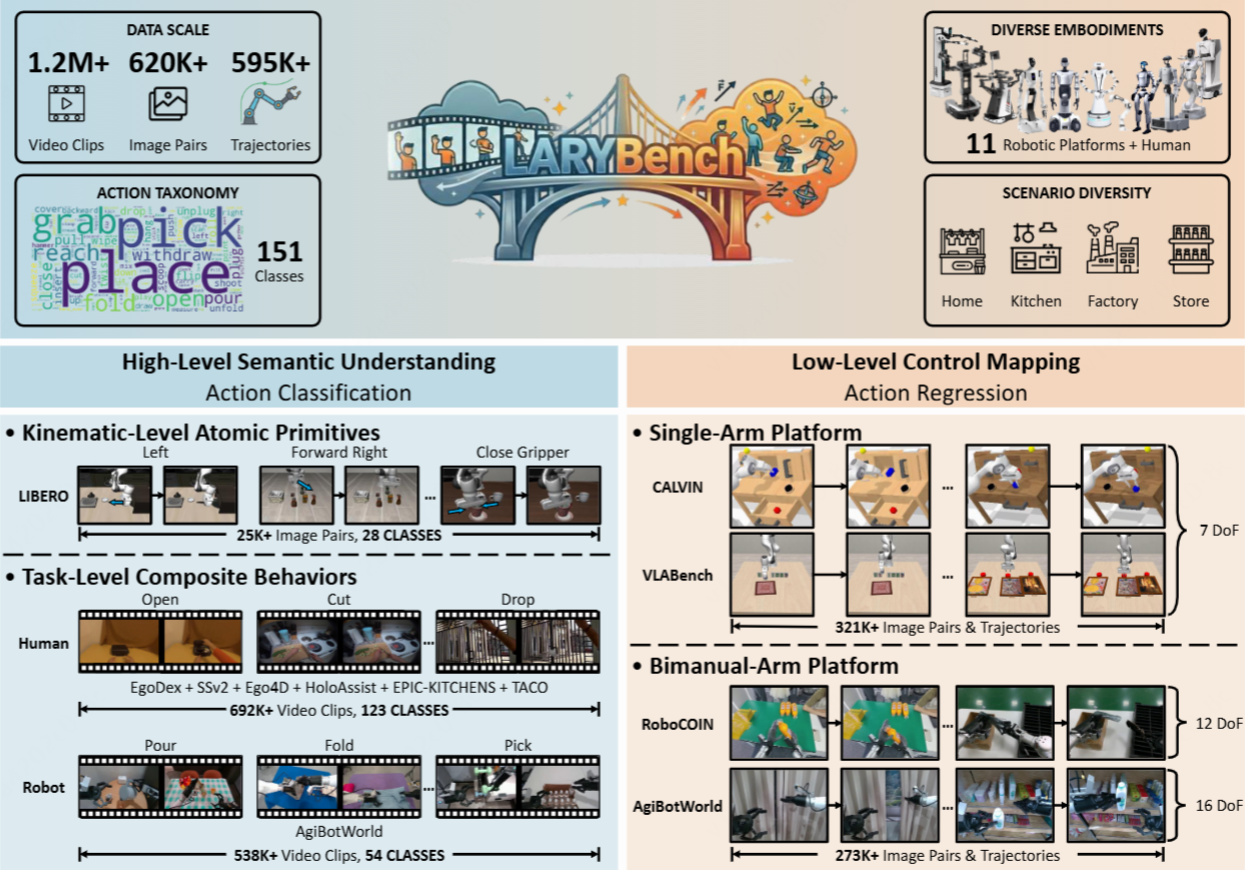
The Meituan Technical Team has officially introduced LARYBench (Latent Action Representation Yielding Benchmark), a systematic evaluation framework designed to guide the learning of general latent action representations from large-scale visual data. Positioned as the 'ImageNet' for the embodied AI sector, LARYBench provides a standardized metric for assessing how well models can translate visual information into actionable robotic control. Experimental data revealed a significant shift in the field: general-purpose vision models consistently outperformed specialized embodied AI expert models in both action generalization and control precision. Most notably, the research confirms that sophisticated embodied action representations can emerge naturally from training on large-scale human video datasets, offering a scalable path forward for robotic intelligence.
Key Takeaways
- Introduction of LARYBench: A new systematic benchmark designed to evaluate and guide the development of general latent action representations from visual data.
- Superiority of General Models: Experimental results demonstrate that general vision models outperform specialized embodied AI expert models in generalization and precision.
- Emergence from Human Videos: The study proves that embodied action representations can emerge from large-scale human video data without requiring specialized robotic datasets.
- Standardizing Embodied AI: LARYBench aims to serve as the 'ImageNet' for the field, providing a foundational metric for measuring progress in robotic action learning.
In-Depth Analysis
Defining a New Standard: LARYBench as the ImageNet for Embodied AI
The release of LARYBench (Latent Action Representation Yielding Benchmark) marks a pivotal moment in the development of embodied artificial intelligence. For years, the field has lacked a unified, systematic benchmark capable of measuring how effectively a model learns latent action representations from diverse visual inputs. By positioning LARYBench as the 'ImageNet' of embodied action, the Meituan Technical Team is providing a standardized framework that allows researchers to quantify the 'generalness' of a model's action representations.
LARYBench focuses on the transition from raw visual data to latent actions—the underlying mathematical representations of movement that a robot can execute. By creating a systematic way to evaluate these representations, the benchmark addresses a critical bottleneck in robotics: the difficulty of assessing whether a model has truly learned a transferable skill or has simply memorized specific trajectories. This systematic approach is essential for moving the industry toward more robust and adaptable AI systems.
The Superiority of General Vision Models in Action Generalization
One of the most striking findings presented alongside the release of LARYBench is the performance gap between general-purpose vision models and specialized 'expert' models. Traditionally, the industry has leaned toward developing expert models specifically tuned for embodied tasks, under the assumption that specialized training would yield higher precision and better control. However, LARYBench's experimental results challenge this convention.
According to the data, general vision models—those trained on vast, diverse datasets not limited to robotics—exhibit significantly better action generalization and control precision than their specialized counterparts. This suggests that a broad understanding of visual physics, spatial relationships, and object permanence (inherent in general vision models) is more valuable for embodied tasks than the narrow, task-specific optimization found in expert models. This discovery implies that the path to high-performance robotics may lie in leveraging the massive scale of general vision pre-training rather than focusing solely on niche robotic datasets.
Emergent Capabilities from Large-Scale Human Video Data
Perhaps the most significant theoretical contribution of the LARYBench research is the confirmation that embodied action representations can 'emerge' from large-scale human video data. This finding provides a solution to the 'data scarcity' problem in robotics. While high-quality robotic execution data is expensive and difficult to collect, human video data is abundant and covers a near-infinite variety of tasks and environments.
LARYBench demonstrates that by observing humans interact with the world through video, AI models can internalize the latent structures of action. This emergence suggests that the fundamental principles of movement and interaction are embedded within visual sequences of human behavior. As models scale and process more human-centric video data, their ability to represent actions in a way that is useful for embodied agents increases, effectively bridging the gap between passive observation and active execution.
Industry Impact
The introduction of LARYBench and the subsequent findings regarding general vision models are set to reshape the embodied AI industry. By proving that general models and human video data are superior for learning action representations, the research shifts the focus of development away from labor-intensive robotic data collection toward the utilization of existing large-scale visual repositories. This could significantly lower the barrier to entry for developing capable robotic systems and accelerate the deployment of general-purpose robots in complex, real-world environments. Furthermore, LARYBench provides the industry with a necessary yardstick to measure progress, ensuring that future breakthroughs in action representation are validated against a rigorous, systematic standard.
Frequently Asked Questions
Question: What exactly is LARYBench and why is it important?
LARYBench stands for Latent Action Representation Yielding Benchmark. It is a systematic evaluation system designed to measure how well AI models learn general action representations from visual data. It is important because it provides a standardized 'ImageNet-like' metric for the embodied AI field, helping researchers track progress in action generalization and control precision.
Question: Why do general vision models perform better than specialized expert models in this benchmark?
The results suggest that general vision models possess a broader understanding of the world, which translates into better generalization across different tasks. Specialized expert models, while optimized for specific actions, often lack the flexibility and precision required when faced with diverse or novel scenarios that general models can handle more effectively.
Question: Can robots really learn how to move just by watching videos of humans?
Yes, the LARYBench research indicates that embodied action representations can emerge from large-scale human video data. This means that by analyzing how humans interact with objects and environments in videos, AI models can learn the underlying latent actions necessary to guide robotic movements, even without direct robotic training data.