
LongCat-Flash-Prover: Meituan Open-Sources AI Model for Rigorous Mathematical Theorem Proving
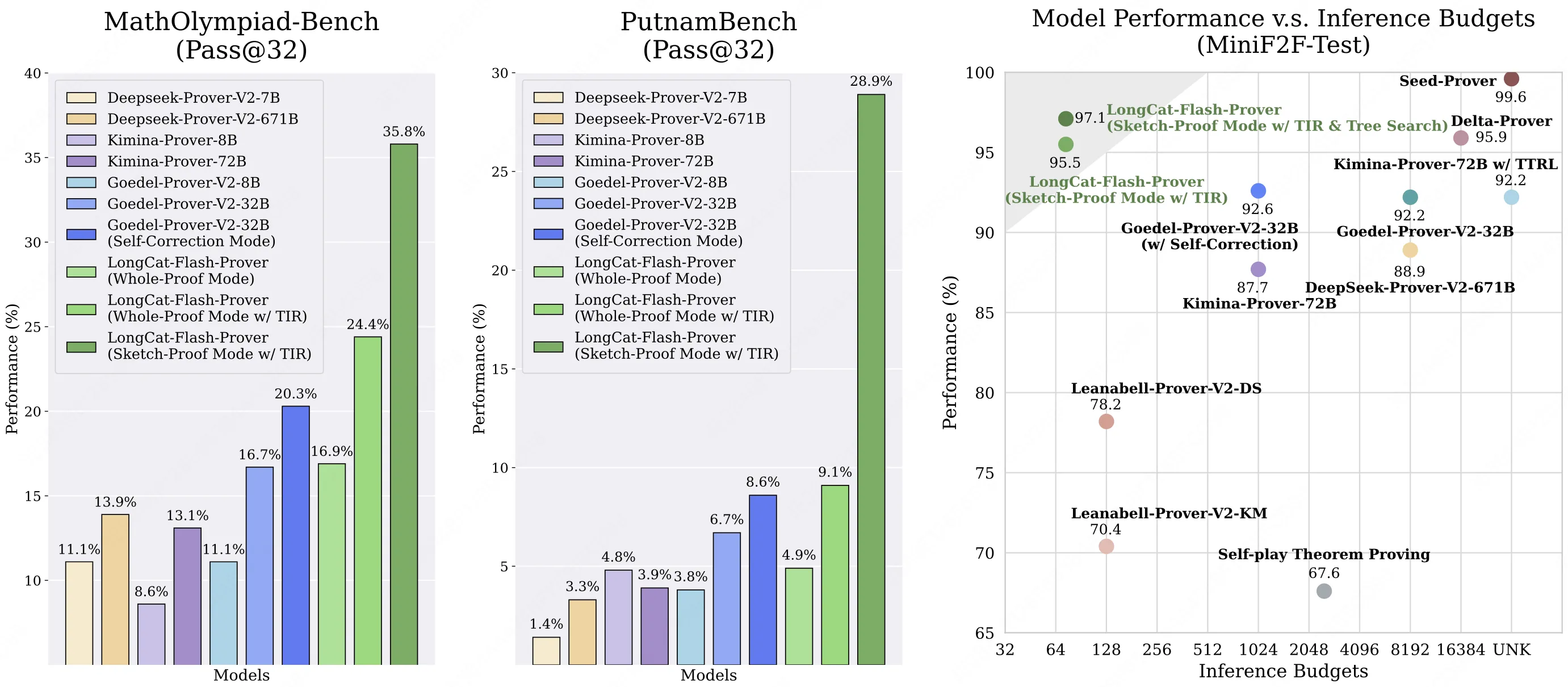
Meituan's technical team has announced the open-sourcing of LongCat-Flash-Prover, a specialized AI model designed for mathematical formalization and theorem proving. Unlike traditional AI models that focus on providing correct numerical answers, LongCat-Flash-Prover addresses the challenge of maintaining strict logical chains required for formal proofs. The model aims to transition AI from "guessing answers" to "rigorous proving," eliminating the ambiguities inherent in natural language that often lead to the collapse of complex mathematical arguments. By focusing on formalization, Meituan provides a tool for the research community to enhance the precision and reliability of AI-driven mathematical reasoning.
Key Takeaways
- Meituan has open-sourced LongCat-Flash-Prover, a model dedicated to mathematical formalization and theorem proving.
- The model prioritizes strict logical rigor over simple numerical accuracy, addressing the needs of complex mathematical reasoning.
- It aims to solve the problem of natural language ambiguity, which can invalidate entire logical chains in traditional AI models.
- The project represents a shift in AI development from predictive "guessing" to verifiable, formal proof generation.
In-Depth Analysis
From Numerical Accuracy to Logical Rigor
The development of LongCat-Flash-Prover marks a significant transition in how artificial intelligence approaches the field of mathematics. In conventional mathematical problem-solving tasks, AI models are typically evaluated on their ability to produce the correct final numerical value. However, the Meituan technical team emphasizes that mathematical theorem proving is a fundamentally different challenge. It requires an extremely strict logical chain where every step must be verified. LongCat-Flash-Prover is designed to meet these rigorous standards, ensuring that the AI does not just "calculate correctly" but "proves rigorously."
The Challenge of Formalization and Ambiguity
A central hurdle in complex reasoning is the ambiguity of natural language. In the context of a mathematical proof, a single vaguely phrased statement or a minor logical gap can cause the entire argument to fail. Meituan's research highlights that for AI to be truly effective in higher-level mathematics, it must move away from the probabilistic nature of "guessing" answers. LongCat-Flash-Prover focuses on the formalization of mathematics, providing a structured approach that minimizes the risks associated with natural language. This focus on formal logic ensures that the reasoning process is robust, transparent, and machine-verifiable.
Open-Sourcing the Future of AI Reasoning
By choosing to open-source LongCat-Flash-Prover, Meituan is providing the global technical community with a specialized tool for exploring the boundaries of formal logic. This move encourages collaborative development in a niche but critical area of AI research. The model serves as a foundation for further studies into how AI can handle tasks that require absolute precision, such as formal verification and automated theorem proving. This initiative reflects a broader commitment to advancing the state of complex reasoning within the open-source ecosystem.
Industry Impact
The release of LongCat-Flash-Prover has significant implications for the AI industry, particularly in fields where logical consistency is non-negotiable. As AI continues to integrate into scientific research, software engineering, and cryptography, the demand for models that can provide verifiable proofs will grow. Meituan’s focus on "rigorous proof" sets a new standard for specialized AI, suggesting that future developments will increasingly prioritize the soundness of the reasoning process over simple output accuracy. This could lead to more reliable AI systems capable of assisting in high-stakes technical and scientific discoveries.
Frequently Asked Questions
Question: How does LongCat-Flash-Prover differ from standard AI math solvers?
Standard AI models often focus on reaching the correct final answer through predictive patterns. In contrast, LongCat-Flash-Prover is specifically designed for theorem proving and formalization, which requires every step of the logical process to be strictly accurate and verifiable.
Question: Why is natural language a problem for mathematical proofs in AI?
Natural language is often ambiguous and lacks the precision required for formal logic. In a mathematical proof, any ambiguity can lead to a logical collapse. LongCat-Flash-Prover addresses this by focusing on formalization, which translates logic into a more precise and rigorous format.
Question: What is the significance of Meituan open-sourcing this model?
By open-sourcing LongCat-Flash-Prover, Meituan allows researchers and developers to access and improve upon a specialized tool for formal reasoning. This fosters innovation in the field of automated theorem proving and helps the industry move toward more reliable and logical AI systems.