Google Search Expands AI Mode Capabilities with Secure Integration for Third-Party Connected Apps
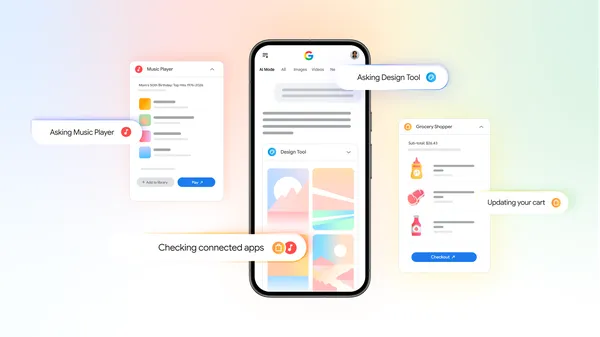
Google has announced a significant update to its Search platform, introducing the ability for users to securely link and interact with their favorite third-party services directly within the platform's 'AI Mode.' This development, revealed via the Google AI Blog, marks a strategic shift from a traditional information-retrieval model to a more functional, action-oriented ecosystem. By integrating 'Connected Apps,' Google aims to streamline user workflows, allowing for seamless interaction with external services without leaving the search interface. The update emphasizes security and user control, ensuring that the process of linking 'go-to services' is both protected and efficient. This move positions Google Search as a centralized hub for digital tasks, leveraging AI to bridge the gap between finding information and executing actions across various applications.
Key Takeaways
- Direct Service Interaction: Users can now interact with their preferred third-party services directly within Google Search's AI Mode.
- Secure Connectivity: The update focuses on the ability to 'securely link' apps, prioritizing data protection and user privacy during the integration process.
- Streamlined Workflow: By connecting apps to Search, Google is reducing the need for users to switch between different applications to complete tasks.
- Evolution of AI Mode: This feature represents a transition for AI Mode from a conversational interface to a functional command center for digital services.
In-Depth Analysis
Bridging Information and Action in AI Mode
The introduction of Connected Apps within Google Search's AI Mode represents a fundamental shift in how users engage with search engines. Traditionally, a search engine served as a gateway—a starting point that directed users to other websites or applications to fulfill their needs. With this latest update, Google is attempting to collapse the distance between the discovery of information and the execution of a task. By allowing users to 'interact with go-to services directly,' AI Mode is evolving into a functional layer that sits on top of the web's vast service ecosystem.
This integration suggests a future where the search bar is not just for queries but for commands. When a user is in AI Mode, the ability to link services means that the AI can act as an intermediary, handling the logistics of cross-platform interaction. This reduces 'context switching'—the cognitive load required to move from one app to another—thereby increasing productivity and user retention within the Google environment. The focus is clearly on making the AI experience more utility-driven, moving beyond simple text generation to tangible service management.
Prioritizing Security in App Connectivity
A critical component of this announcement is the emphasis on security. Google specifies that users will be able to 'securely link' their services. In an era where data privacy is a primary concern for consumers, the success of an integrated search ecosystem depends entirely on trust. Linking 'go-to services'—which likely include personal, financial, or productivity tools—requires a robust security framework to ensure that sensitive data is not compromised during the interaction between the search interface and the third-party API.
By highlighting the secure nature of these connections, Google is addressing potential user hesitation regarding the sharing of access tokens or personal information with an AI interface. The 'Connected Apps' framework likely utilizes advanced authentication protocols to ensure that the AI only accesses the specific data necessary to perform the requested interaction. This focus on security is not just a technical requirement but a strategic necessity to encourage widespread adoption of AI Mode as a primary interface for daily digital activities.
Industry Impact
The move to integrate connected apps into a search-based AI interface has profound implications for the broader tech industry. First, it challenges the traditional 'app silo' model. If users can perform the core functions of their favorite apps through Google Search, the individual app interfaces may become secondary to the AI-driven 'super-interface.' This could change how developers design their services, potentially prioritizing API functionality and AI compatibility over standalone UI/UX.
Furthermore, this development intensifies the competition among AI providers. As search engines like Google and its competitors vie for dominance, the winner will likely be the one that offers the most comprehensive and seamless integration with the services users already rely on. By turning Search into a platform for action, Google is reinforcing its position in the AI arms race, moving toward a model where the AI assistant is the primary lens through which the entire internet is navigated and utilized.
Frequently Asked Questions
Question: What is the primary benefit of connecting apps to Google Search?
Answer: The primary benefit is the ability to interact with your favorite services directly within AI Mode. This allows for a more streamlined experience where you can complete tasks and manage services without having to leave the search results or switch between different applications.
Question: How does Google ensure the safety of my data when linking apps?
Answer: According to the announcement, the integration is designed to let users 'securely link' their services. This implies that Google is using secure authentication and data protection protocols to ensure that interactions between the search interface and your third-party apps remain private and protected.
Question: Can I use this feature in the standard Google Search interface?
Answer: The announcement specifically mentions that these interactions and app links occur 'directly in AI Mode.' This suggests that the feature is a specialized enhancement for the AI-driven search experience rather than the traditional search results page.