
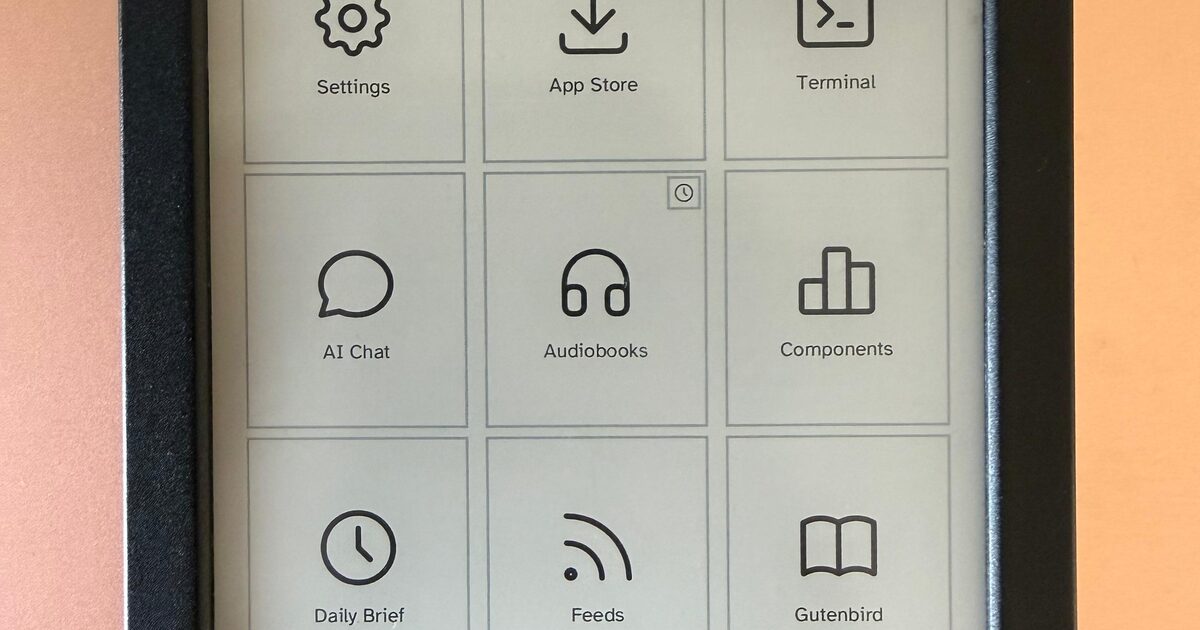
Cobalt Open-Source Platform Brings Apps and SDK to Kobo E-Readers via New App Store
Cobalt has emerged as a transformative open-source application platform designed specifically for Kobo e-readers. It introduces a comprehensive ecosystem featuring a launcher, a signed App Store, a Rust-based SDK, and a secure runtime environment where apps operate in unprivileged processes. Users can install Cobalt once via USB, after which all subsequent application management—including installations, updates, and removals—occurs over Wi-Fi directly on the device. The platform maintains the integrity of the original device, as a simple reboot restores the stock Kobo reader interface. Initial applications include an arXiv paper reader, a Sudoku game, and 'Sidekick' for AI coding agent interactions, showcasing the platform's ability to handle complex tasks like math notation and local network pairing. This development marks a significant shift in e-reader utility, moving beyond simple book consumption.
Key Takeaways
- New Ecosystem: Cobalt provides an open-source platform for Kobo e-readers, including a launcher, a signed App Store, and a Rust SDK.
- Security-First Design: Every application runs as a static ARM binary within its own unprivileged process on stock hardware, with signatures verified before launching.
- Seamless Updates: After an initial USB installation, all app management (install, update, remove) is handled over Wi-Fi directly on the reader.
- Reversible Modification: A simple device reboot returns the Kobo e-reader to its original stock software state.
- Diverse App Library: Early apps include an arXiv reader for academic papers, a Sudoku game, and 'Sidekick' for interacting with AI coding agents like Claude Code.
In-Depth Analysis
The Cobalt Architecture: Security and Performance
Cobalt represents a sophisticated approach to expanding the functionality of E-Ink devices without compromising the underlying system's stability. At its core, Cobalt is built on a Rust-based Software Development Kit (SDK) and a runtime environment that prioritizes security through isolation. Unlike traditional e-reader modifications that might risk system-wide instability, Cobalt ensures that every application operates as a static ARM binary. These binaries run as unprivileged processes, meaning they are restricted from accessing sensitive system areas unless explicitly permitted.
Furthermore, the platform introduces a robust verification system. The integrated App Store uses signed applications, ensuring that any software downloaded over Wi-Fi is verified for authenticity before it is allowed to launch. This architecture allows the Kobo Clara BW and similar stock hardware to function as a versatile computing device while maintaining the low-power, high-stability profile expected of an e-reader.
Expanding Utility: From Academic Research to AI Integration
The initial suite of applications available on Cobalt demonstrates the platform's potential to transform e-readers into specialized productivity tools. One of the standout features is the arXiv app, which leverages the HTML renderings published by arXiv since late 2023. This allows researchers to browse preprints and read full-text papers—complete with complex math notation, numbered algorithms, and result tables—all paginated specifically for the E-Ink panel.
Beyond academic consumption, Cobalt bridges the gap between e-readers and modern AI workflows. The Sidekick app allows the Kobo to pair over a local network to display questions and tappable answers from Claude Code. This suggests a future where e-readers serve as secondary, distraction-free displays for developers and power users. Other creative uses include Audiobook Studio, which is capable of researching, writing, narrating, and playing original audiobooks, and Morse, which utilizes the device's front light to transmit messages.
User Experience and Installation Workflow
Cobalt is designed with a focus on user accessibility and non-destructive modification. The installation process requires a one-time setup via USB. Once the platform is active, the user interacts with a dedicated Launcher that serves as the gateway to all installed applications. The inclusion of a Wi-Fi-enabled App Store is a significant quality-of-life improvement for the e-reader community, as it removes the need for frequent tethering to a computer to manage software.
Crucially, Cobalt respects the original device software. Because it operates alongside the stock environment, a simple reboot is all that is required to return the device to the standard Rakuten Kobo reading interface. This "opt-in" approach reduces the barrier to entry for users who want to experiment with third-party apps without permanently altering their device's primary function as a book reader.
Industry Impact
The launch of Cobalt signifies a growing trend toward "extensible E-Ink" devices. By providing a formal SDK and a secure runtime, Cobalt moves the Kobo community away from fragmented, unofficial hacks toward a structured developer ecosystem. This could pressure e-reader manufacturers to reconsider their closed-garden approaches, as users increasingly demand the ability to use their E-Ink screens for more than just EPUB and PDF consumption.
Specifically, the integration of academic paper reading and AI agent interaction positions the e-reader as a viable tool for the professional and scientific sectors. If Cobalt gains traction, it may inspire a new wave of E-Ink-optimized software, potentially leading to a niche market of "distraction-free" productivity devices that leverage the unique battery life and visibility benefits of electronic paper technology.
Frequently Asked Questions
Question: Does installing Cobalt void my Kobo warranty or permanently change the OS?
Cobalt is designed to be non-permanent. While it is installed over USB, a simple reboot of the device returns it to the stock Kobo reader software. It runs on stock hardware and does not appear to replace the underlying operating system permanently.
Question: How are apps updated on the Cobalt platform?
After the initial installation of the Cobalt platform via USB, all subsequent apps are managed through the on-device App Store. This allows for installing, updating, and removing signed applications directly over Wi-Fi without needing to connect to a computer again.
Question: What kind of hardware is required to run Cobalt?
The original news confirms that Cobalt runs on stock Kobo hardware, specifically mentioning and showing it running on the Kobo Clara BW. It uses static ARM binaries to ensure compatibility with the device's processor.