
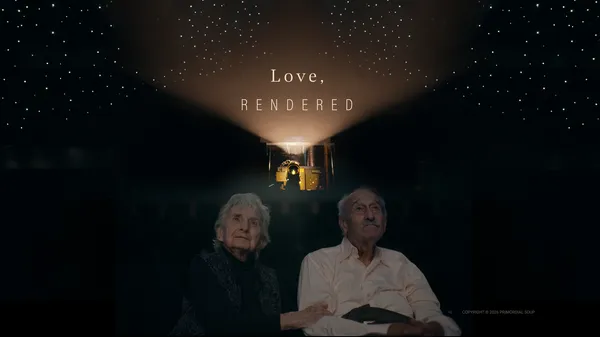
Recreating a 70-Year Love Story Frame by Frame: How Google DeepMind and Filmmakers Rendered Lost Memories
Google DeepMind has collaborated with documentary filmmakers to produce "Love, Rendered," a short film that leverages cutting-edge artificial intelligence to reconstruct the unrecorded past of a couple married for over seven decades. Confronting the unique challenge of depicting cherished life moments that were never preserved on camera or film, the production team utilized generative AI models frame by frame to bridge historical visual gaps. By blending archival photo restoration with performance capture techniques, the project mapped the couple's present-day mannerisms onto younger visual likenesses. This collaboration illustrates how emerging machine learning frameworks can function as expressive artistic mediums, opening compelling new frontiers for documentary cinema, personal history preservation, and human-guided generative storytelling.
Key Takeaways
- Pioneering Memory Reconstruction: Google DeepMind collaborated with filmmakers on the documentary short "Love, Rendered" to visually recreate moments from a 70-year love story that had never been captured on camera.
- Frame-by-Frame AI Synthesis: The production team utilized generative artificial intelligence models to construct authentic visual scenes frame by frame, transforming spoken recollections and emotions into tangible moving imagery.
- Human Direction Guiding Technology: Rather than relying on autonomous generation, filmmakers and AI engineers used machine learning as an artistic medium, combining photo restoration and performance capture to reflect the couple's true mannerisms.
- Emotional Preservation and Digital Heritage: The project demonstrates how advanced generative tools can move beyond commercial novelty to support personal legacy preservation and address cognitive memory decline.
- A New Paradigm for Documentary Filmmaking: This initiative marks an evolving intersection of cinema and deep learning, setting a precedent for reconstructing historical and personal archives where physical documentation is entirely missing.
In-Depth Analysis
Reconstructing the Unrecorded: The Visual Genesis of "Love, Rendered"
Documentary filmmaking has historically depended on primary visual evidence—photographs, home videos, audio tapes, and archival paper records. When key historical moments were never recorded, filmmakers were traditionally forced to rely on dramatic reenactments, abstract animations, or voiceover narrations over unrelated B-roll. The short film "Love, Rendered" breaks through this structural constraint by deploying generative artificial intelligence to reconstruct the unrecorded beginnings of a couple's 70-year romance.
At the core of the project was the challenge of navigating fading memories and cognitive decline. Because the couple's earliest milestone—their first meeting decades ago—was never photographed or filmed, it survived exclusively within their shared recollections. To materialize this intangible history, engineers from Google DeepMind worked alongside filmmakers to translate intimate oral accounts into detailed, historically faithful visual representations. Generative models were deployed to build the narrative frame by frame, ensuring that setting, lighting, and period details mirrored the authentic context of the era while honoring the emotional integrity of the couple's testimony.
Precision Synthesis: Blending Performance Capture and Archival Restoration
Synthesizing human likenesses across multiple decades poses severe technical hurdles, particularly the risk of falling into the "uncanny valley," where subtle synthetic errors alienate the viewer. To overcome this obstacle, the technical team at Google DeepMind implemented a hybrid generative workflow that combined archival still restoration with advanced performance capture techniques.
The process began with surviving black-and-white photographs from the couple's youth, which were enhanced and restored using machine learning models to recover lost details, contours, and skin textures. However, still images alone could not convey the natural movement and emotional warmth of genuine human memory. To solve this, the filmmakers captured the couple's present-day facial expressions, micro-mannerisms, and interaction patterns. Generative models then mapped these unique, individualized behavioral cues onto the restored younger likenesses. This human-centered approach ensured that the AI-generated frames did not merely display generic historical reconstructions, but faithfully represented the real individuals and their lifelong bond.
Generative AI as an Artist's Toolkit Rather Than an Autonomous Replacement
"Love, Rendered" presents a notable methodological case study in how creative industries can incorporate advanced generative AI without displacing human authorship. Throughout the project's development, emerging AI systems were treated strictly as an artistic medium and collaborative toolkit guided by human sensibility. The filmmakers maintained direct control over tone, composition, pacing, and emotional focus, treating generative algorithms much like an animator treats a digital canvas.
Crucially, the subjects themselves played an active role in steering the generation process, validating whether reconstructed environments, clothing, and gestures aligned with their lived experiences. This collaborative feedback loop allowed machine learning models to iteratively refine individual visual assets until the reconstructed past felt emotionally genuine. The production shows that the true utility of AI in visual arts lies not in automated mass generation, but in its ability to empower creators to visualize previously impossible narratives with surgical precision.
Industry Impact
Expanding the Boundaries of Documentary Storytelling
The methodologies unveiled in "Love, Rendered" carry significant implications for the entertainment and non-fiction film industries. By proving that missing historical and personal moments can be reconstructed with authentic fidelity, the project expands the visual vernacular available to documentarians. Biographers, historians, and investigative creators can now visualize critical unrecorded events—from oral histories and lost cultural traditions to remote historical incidents—while maintaining grounded authenticity through survivor input and archival benchmarks.
Transforming Personal Archiving and Memory Preservation
Beyond professional filmmaking, the technology demonstrated by Google DeepMind signals a profound evolution in consumer memory preservation and digital heritage. As generative image restoration and personal styling models advance, everyday users will increasingly gain access to tools capable of transforming fragmented photo collections into dynamic, animated visual histories. This has meaningful applications in elder care, reminiscence therapy, and family history preservation, offering families powerful new ways to celebrate and protect generational legacies before memories fade.
Directing AI Research Toward Empathetic, Human-Centric Applications
For major artificial intelligence research organizations like Google DeepMind, "Love, Rendered" highlights an important strategic shift toward human-centric, emotionally resonant applications. While much of the recent public debate surrounding generative video and imagery has centered on copyright concerns, efficiency gains, or automated marketing, this initiative underscores AI's capacity for empathy, historical preservation, and artistic collaboration. Demonstrating practical, ethical, and emotionally uplifting implementations will be critical as frontier AI labs work to build public trust in generative media.
Frequently Asked Questions
What is the primary focus of the short film "Love, Rendered"?
"Love, Rendered" is a documentary short film that tells the story of an elderly couple married for more than 70 years. Facing cognitive decline and memory loss, the couple collaborated with filmmakers and Google DeepMind engineers to recreate their earliest, unphotographed moments together using artificial intelligence.
How did Google DeepMind use AI to reconstruct moments that were never filmed?
The production team used generative machine learning models to restore old black-and-white family photographs and paired these historical assets with modern performance capture. By analyzing the couple's present-day micro-mannerisms and expressions, the team mapped these authentic behavioral traits onto their younger likenesses, producing a coherent visual recreation frame by frame under human artistic guidance.
What does "Love, Rendered" reveal about the future of AI in cinematic production?
The film reveals that generative AI can serve as a nuanced creative toolkit for filmmakers rather than a replacement for human artistry. It demonstrates that combining machine learning with direct human testimony allows artists to portray deeply personal, unrecorded histories that were previously unreachable through conventional archival documentary methods.
