
Back to list
How LangChain Built Its GTM Agent to Generate High-Quality Sales Artifacts
Industry NewsLangChainAI AgentsSales Automation

How LangChain Built Its GTM Agent to Generate High-Quality Sales Artifacts

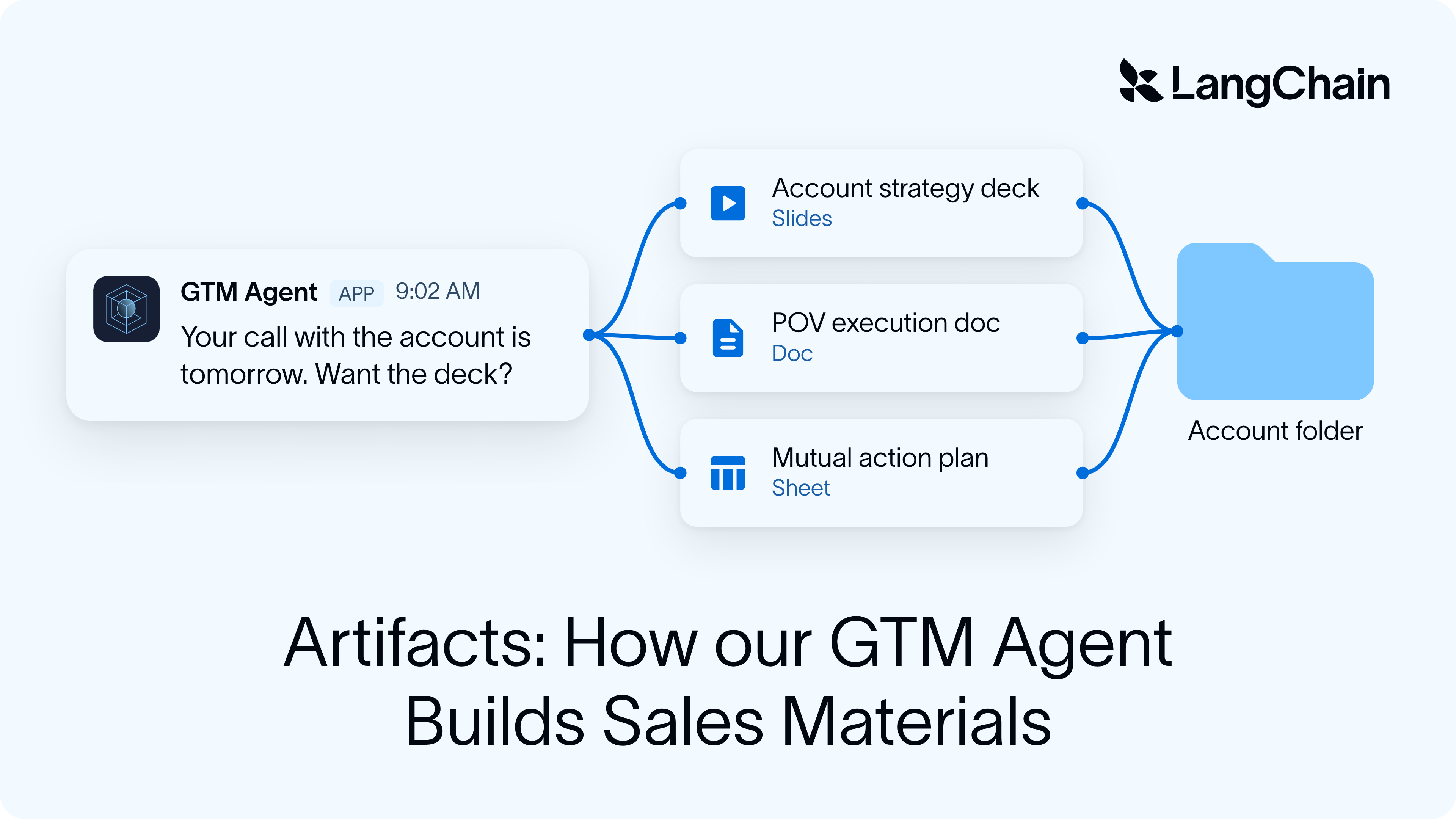
LangChain shares insights into how their team built a Go-To-Market (GTM) agent utilizing Deep Agents. Designed to streamline and automate outbound sales workflows, the agent leverages business context to create high-quality, custom sales artifacts. This approach addresses complex orchestration challenges, helping sales and GTM teams scale operations reliably using advanced AI agent frameworks.

LangChain

Key Takeaways

  • LangChain built a specialized GTM Agent using Deep Agents to streamline sales workflows.
  • The agent is trained and customized using specific business context.
  • The primary goal focuses on creating high-quality, custom sales artifacts efficiently.

In-Depth Analysis

Leveraging Deep Agents for Sales Workflows

LangChain's development of the GTM Agent demonstrates the practical application of Deep Agents within enterprise sales environments. By moving beyond simple prompting, the system integrates deep context handling and multi-step execution capabilities. This framework allows the agent to handle sophisticated tasks tailored specifically to commercial pipelines without losing systemic consistency.

Customization Through Business Context

Building high-quality sales artifacts requires deep alignment with internal business data and messaging standards. The GTM Agent is trained on specific business context, ensuring that the outputs generated match the brand voice, technical accuracy, and strategic goals required by go-to-market teams.

Industry Impact

The integration of Deep Agents into sales operations marks a shift toward more specialized, context-aware automation in enterprise software. By demonstrating how custom sales artifacts can be reliably generated using tailored agent architectures, LangChain highlights a scalable path for organizations looking to merge LLM capabilities with complex business processes.

Frequently Asked Questions

What framework was used to build LangChain's GTM Agent?

The GTM Agent was built using Deep Agents.

What is the primary function of the GTM Agent?

The agent builds high-quality, custom sales artifacts that are trained on specific business context.

Related News

Japanese Investors Seek $9.4 Billion in Anthropic IPO Shares and Receive $2.98 Billion
Industry News

Japanese Investors Seek $9.4 Billion in Anthropic IPO Shares and Receive $2.98 Billion

Japanese investors sought $9.4 billion in shares in Anthropic’s initial public offering and were ultimately allotted US$2.98 billion, Tech in Asia reported. The report cites a filing for the final allotment. The two figures describe different things: the $9.4 billion is the reported value of the shares Japanese investors sought, while the US$2.98 billion is the value of the shares they were allotted. The allotment was therefore lower than the amount sought. The available report does not identify the investors, explain why the allotment was lower, or give the overall size of the offering. It documents demand and allocation for Japanese investors without establishing how that demand compared with interest from other investors.

Apple Is Hiring to Build an AI Agent That Can Work Across Apps
Industry News

Apple Is Hiring to Build an AI Agent That Can Work Across Apps

Apple is looking for an engineer to lead the creation of its own agentic AI assistant, according to a job listing spotted by Bloomberg and reported by The Verge. The assistant is described as being able to browse the web, work across apps, write code, and call services on a user's behalf. The listing is notable for the range of tasks it names: it describes an assistant that does work for users, rather than establishing how any one capability would function. The available report concerns hiring and the scope of the project. It does not announce a release or say which apps and services the assistant would be able to use.

Meta’s Muse Charm AI Wearable May Cost $300, but Meta Has Not Confirmed the Price
Industry News

Meta’s Muse Charm AI Wearable May Cost $300, but Meta Has Not Confirmed the Price

Meta’s upcoming Muse Charm AI wearable may cost $300, according to a TechCrunch AI article by Lucas Ropek that cites reporting from The Information. Meta did not deny the reporting, saying only that it would “have more to share soon” about the wearable. The distinction is that $300 is a reported possibility, not an official price. Meta’s response indicates that it expects to share more information, but it does not say when that will happen or whether the next update will address pricing. For now, the article establishes that Muse Charm is an upcoming AI wearable and that $300 has been reported as a possible price.