
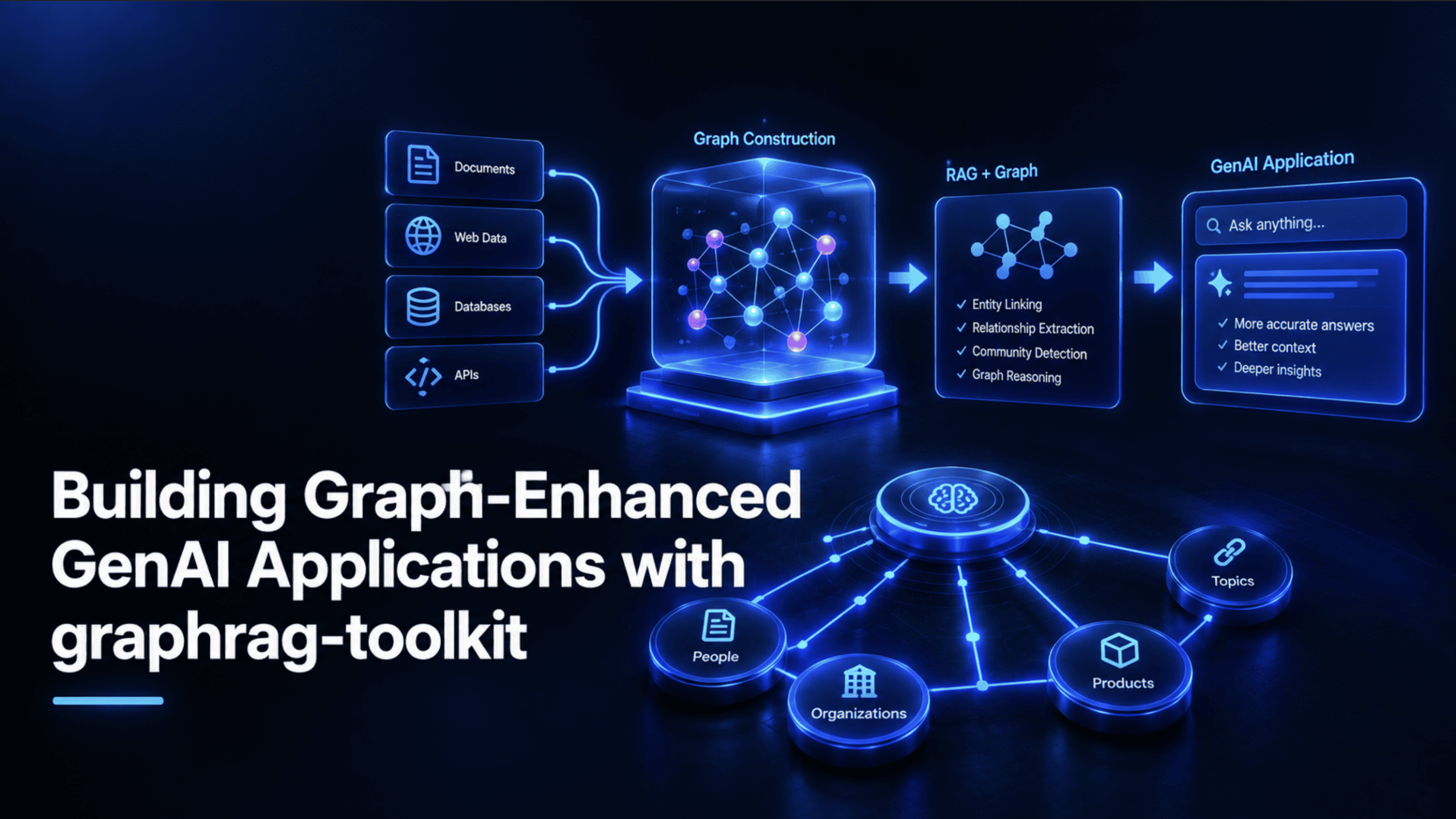
Building Graph-Enhanced GenAI Applications with AWS Labs' graphrag-toolkit
Discover how graph-enhanced Retrieval-Augmented Generation (RAG) bridges the gaps left by traditional vector search by connecting related facts through structured relationships. This comprehensive guide explores the implementation of a multi-hop research assistant leveraging AWS Labs' open-source graphrag-toolkit, Neo4j, and pgvector. Learn how to extract unstructured data, build hierarchical lexical graphs, and set up production-ready GenAI workflows that handle complex queries effectively.
Key Takeaways
- Understand how graph-enhanced RAG connects related facts that conventional vector searches typically miss.
- Learn to build a multi-hop research assistant utilizing AWS Labs' open-source graphrag-toolkit alongside Neo4j and pgvector.
- Explore the separation of extraction and building stages within the pipeline for resumable, micro-batched data ingestion.
- Discover how to implement structured knowledge graphs to handle complex user queries that demand multi-step reasoning.
In-Depth Analysis
Overcoming Vector Search Limitations with Graph-Enhanced RAG
Traditional vector search approaches excel at semantic matching based on text similarity, but they often fail to connect related facts that are dispersed across multiple documents or lack direct string proximity. Graph-enhanced retrieval-augmented generation solves this limitation by querying structured knowledge graphs instead of relying strictly on plain vector indexes. This methodology allows applications to follow actual relationships between individual pieces of information, enabling deeper contextual understanding and reducing blind spots inherent in standard semantic searches.
Building a Multi-Hop Research Assistant Using graphrag-toolkit
AWS Labs' open-source graphrag-toolkit provides a robust Python-based framework designed to streamline the creation of graph-enhanced Generative AI applications. By integrating tools like Neo4j and pgvector, developers can construct sophisticated architectures capable of executing multi-hop reasoning. The process involves handling raw unstructured source materials, extracting relevant entities, facts, and topics, and systematically building an interconnected graph structure that powers advanced assistant capabilities.
Industry Impact
The integration of graph databases with generative artificial intelligence marks a significant step forward in production-grade AI reliability. By moving beyond isolated vector similarity and embracing connected intelligence via tools like the graphrag-toolkit, organizations can build domain-specific assistants that answer complex, multi-step queries accurately. This reduces hallucinations, makes knowledge retrieval transparent, and provides developers with robust open-source foundations for enterprise-level GenAI deployments.
Frequently Asked Questions
Question: What is graph-enhanced RAG and how does it differ from vector search?
Answer: Graph-enhanced RAG queries a knowledge graph rather than relying solely on a plain vector index. While vector search finds text based on semantic similarity, graph-enhanced RAG follows actual structured relationships between information pieces to connect related facts that vector search might miss.
Question: What components are used to build the multi-hop research assistant?
Answer: The multi-hop research assistant is built using AWS Labs' open-source graphrag-toolkit, Neo4j, and pgvector.


