
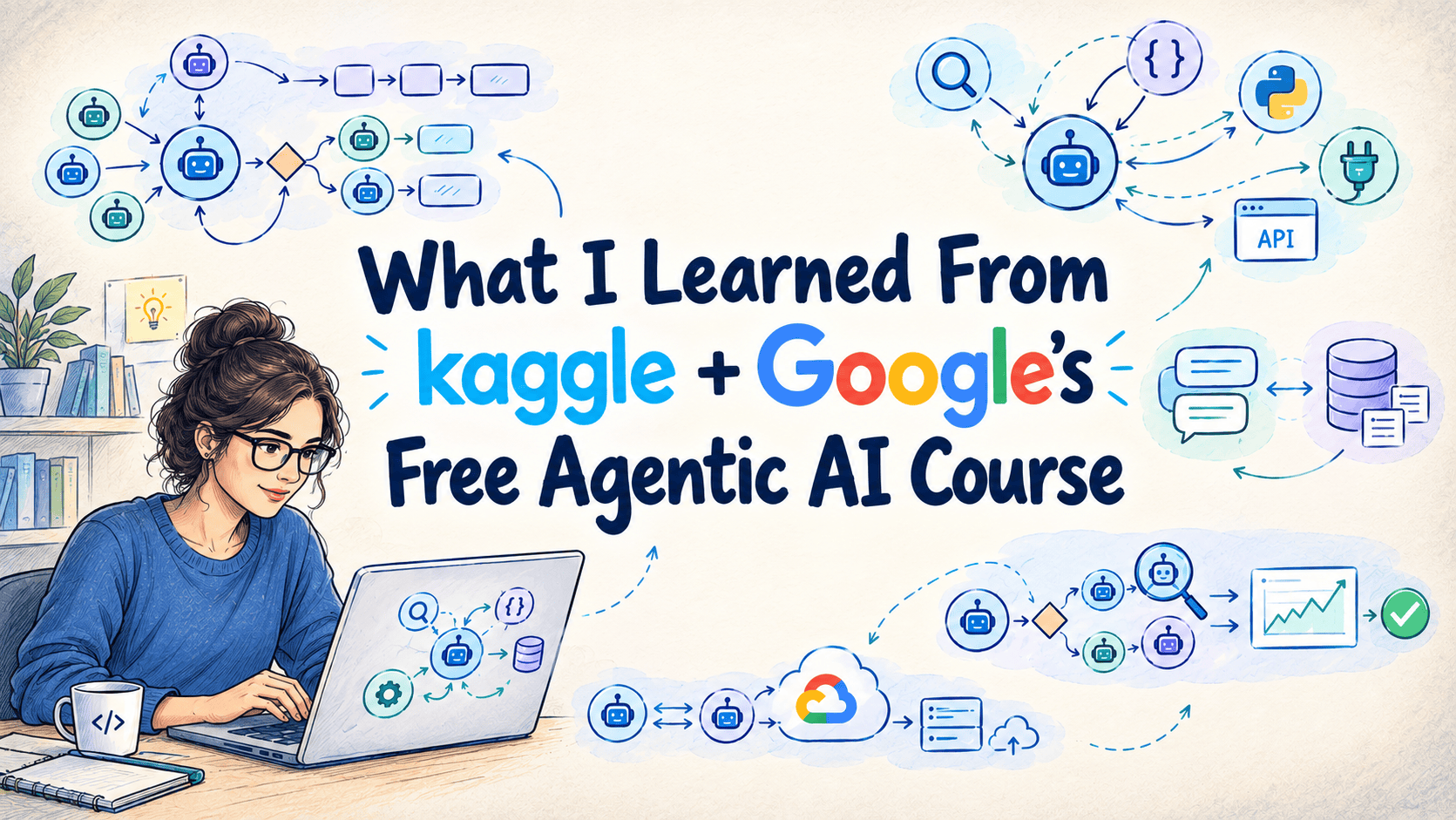
Kaggle and Google’s Free Agentic AI Course: What It Covers With Gemini and ADK
In a KDnuggets article, Bala Priya C shares what they learned from Kaggle and Google’s free agentic AI course. The course teaches learners to build AI agents with Gemini and Google’s ADK. The published description names four areas of coverage: tools, memory, evaluation, and deployment. Together, those topics frame the course around both building agents and considering how to evaluate and deploy them. The description does not specify the course length, prerequisites, lesson sequence, or depth of coverage for each topic. For readers deciding whether to look further, the clearest takeaway is the course’s focus: agent development with Gemini and Google’s ADK.
Key Takeaways
- KDnuggets published Bala Priya C’s account of what they learned from Kaggle and Google’s free agentic AI course.
- The course teaches learners to build AI agents using Gemini and Google’s ADK.
- The published description names four topics: tools, memory, evaluation, and deployment.
- The description identifies what the course covers but does not specify prerequisites, course length, or the depth of individual lessons.
In-Depth Analysis
Building AI agents with Gemini and Google’s ADK
The clearest detail in the KDnuggets description is what learners are meant to build and what they are meant to use: AI agents, with Gemini and Google’s ADK. That makes the course easier to assess than the label “agentic AI” alone. A reader who is specifically interested in building agents with those technologies can see the connection immediately. At the same time, the short description does not explain how Gemini and ADK are used together, how much time is devoted to either, or what a completed agent looks like. It also helps to distinguish the course from the article about it. Bala Priya C’s title frames the article as a personal account of learning from the course, while the supplied description identifies the subject of that learning. The description does not give enough detail to reconstruct the author’s individual lessons or to attribute a verdict on the course to them.
How tools, memory, evaluation, and deployment define the scope
The four named topics give readers a more useful picture of the course than the build objective alone. Tools and memory are named alongside evaluation and deployment, so the description presents agent development as a subject that includes more than the initial act of building an agent. The inclusion of evaluation and deployment is particularly useful for a reader checking whether those subjects are part of the offering at all. But coverage is not the same as depth: naming evaluation does not tell readers how agents are evaluated, and naming deployment does not tell them where or how an agent is deployed. The same distinction applies to tools and memory. Both are explicitly included, but neither is described at the level of a lesson or an implementation. Nor does the order of the topics in the description establish a teaching sequence. In short, the list works as a guide to what is in scope, not as a detailed syllabus.
What the free course label does—and does not—tell readers
The description makes one access-related point clear: the course is free. Together with the named technologies and topics, that gives readers a basis for an initial decision about whether to look into it. Someone looking for a free course on agent development with Gemini and Google’s ADK can identify it as relevant; someone looking for a particular evaluation method or deployment environment cannot determine from the description whether it is a match. Price and course fit are different questions. The word “free” does not say how much time the course takes, what learners are expected to know beforehand, or how deeply they will work with each topic. Those gaps are not evidence that the course lacks detail or structure. They simply mark the limits of what can be concluded from the KDnuggets description.
Industry Impact
For readers following AI developer education, the significance of the course is in what it teaches together: agent building with Gemini and Google’s ADK, plus explicit coverage of tools, memory, evaluation, and deployment. The named technologies make this a concrete example of what an agentic AI course can focus on. The topics also offer a basis for comparing its stated scope with other training descriptions, without assuming that courses using the same “agentic AI” label cover the same material.
Evaluation and deployment matter to that comparison because they are visible in the description rather than left for readers to infer from the promise of building an agent. A reader interested in those areas can confirm that the course includes them, even if the description cannot establish whether the coverage is detailed enough for a particular goal. That is the main industry-facing takeaway supported by the source: the course presents evaluation and deployment as part of agent development education alongside tools and memory. The article description does not report adoption, learner outcomes, or effects on the wider AI industry, so it does not support conclusions about the course’s broader influence.
Frequently Asked Questions
What does Kaggle and Google’s free agentic AI course teach?
It teaches learners to build AI agents with Gemini and Google’s ADK. The KDnuggets description lists tools, memory, evaluation, and deployment as topics the course covers.
Does the course cover evaluation and deployment?
Yes. Both are explicitly named in the description. The source does not specify evaluation methods, deployment environments, or how much of the course is devoted to either topic.
Who wrote about the course, and where was the article published?
Bala Priya C wrote about what they learned from the course. The article was published by KDnuggets on November 19, 2026.