The 45x Cost Penalty: Why AI Vision Agents Struggle Against Structured APIs in New Benchmarks
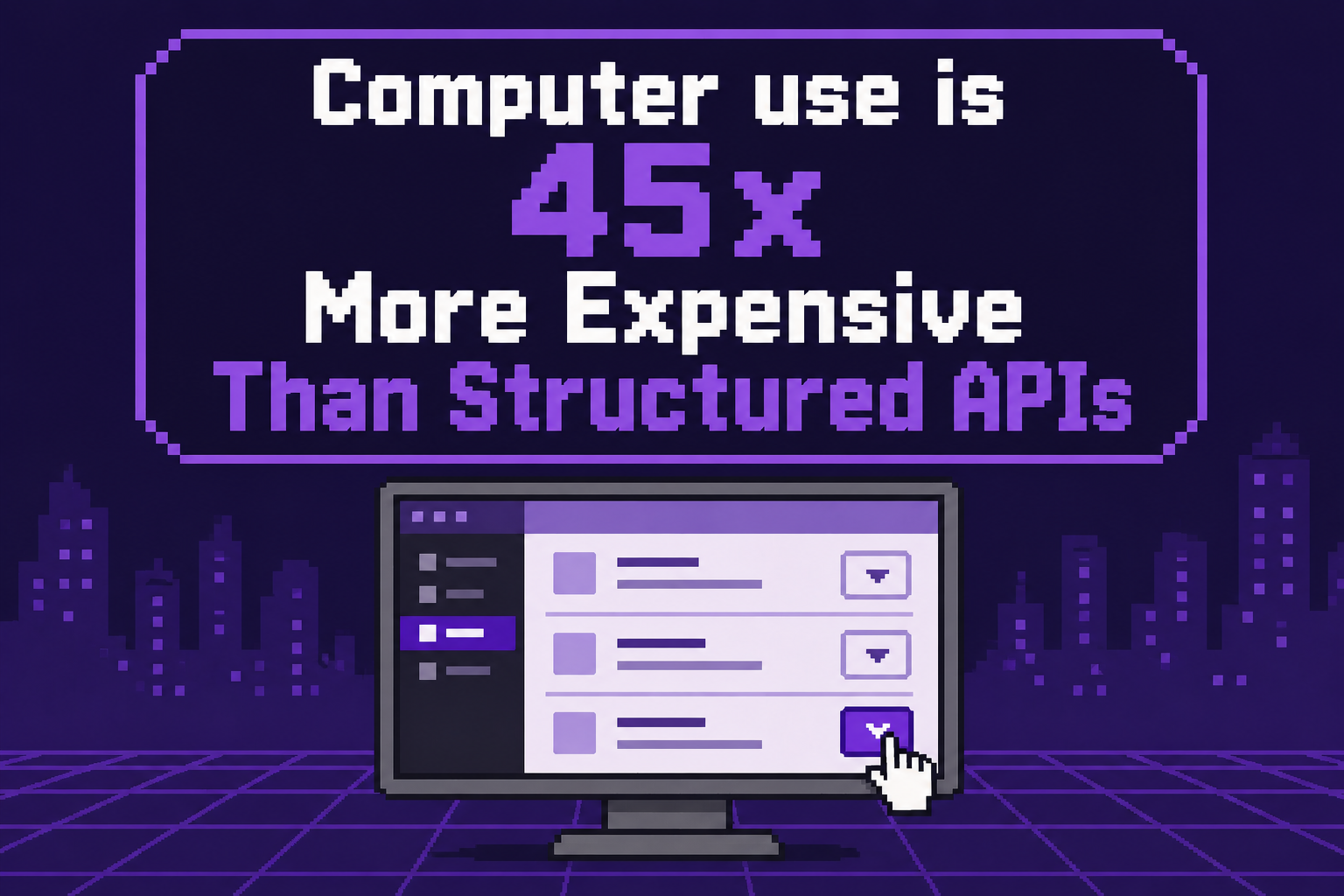
A recent benchmark study by Reflex.dev has revealed a staggering cost disparity between two primary methods of AI agent operation: vision-based 'computer use' and structured API interaction. By testing Claude Sonnet on a standardized admin panel task, researchers found that vision agents—which interact with interfaces via screenshots and clicks—are 45 times more expensive than agents using direct HTTP endpoints. While many development teams default to vision agents to avoid the heavy engineering overhead of building custom APIs for numerous internal tools, this study quantifies the massive operational price tag associated with that choice. The findings highlight a critical economic trade-off in the AI industry: the immediate convenience of vision-based automation versus the long-term efficiency and cost-effectiveness of structured data interfaces.
Key Takeaways
- Massive Cost Gap: Vision-based AI agents (computer use) are 45 times more expensive to operate than agents using structured APIs for the same task.
- Standardized Testing: The benchmark utilized Claude Sonnet to manage an admin panel, comparing screenshot-based navigation (Path A) against direct HTTP endpoint calls (Path B).
- Complex Workflows: The test involved real-world internal tool operations, including filtering, pagination, cross-entity lookups, and both read/write actions.
- Engineering Trade-offs: Teams often choose vision agents not for superior performance, but to avoid the 'engineering project' of creating API surfaces for dozens of internal tools.
- Open Source Transparency: The benchmark data and code are open source, providing a clear look at the operational costs of 'vision mode' in AI agents.
In-Depth Analysis
Benchmarking Vision vs. Structured Interaction
The core of the Reflex.dev study involved a head-to-head comparison of two distinct methodologies for AI agent operation. The researchers used a test application modeled after the 'Posters Galore' demo, a standard admin panel for managing customers, orders, and reviews. Two different paths were established for the AI agent, both powered by the same Claude Sonnet model and the same pinned dataset to ensure the interface was the only variable.
Path A utilized the 'Vision' approach, where the agent drove the UI via browser-use version 0.12. In this mode, the agent processed the application by taking screenshots and executing clicks, mimicking human interaction with a web browser. Path B utilized the 'API' approach, where the agent was equipped with tool-use capabilities to call HTTP endpoints directly. These endpoints mapped to the same event handlers that a button click would trigger in the UI, but the agent received structured data responses instead of rendered visual pages. The result was a definitive 45x price difference, proving that the computational and token-heavy nature of processing visual data significantly inflates operational costs compared to structured data exchange.
The Complexity of Internal Tool Operations
The benchmark was designed to reflect the 'shape of work' that typical internal tools handle daily. The specific task assigned to the agents was multi-faceted: find a customer named 'Smith' with the highest order count, locate their most recent pending order, accept all of their pending reviews, and finally mark the order as delivered. This sequence required the agents to perform complex operations including filtering through datasets, navigating pagination, and conducting cross-entity lookups across customers, orders, and reviews.
By requiring both read and write operations, the benchmark tested the reliability and efficiency of the agents in a high-stakes environment. The study found that while vision agents are capable of performing these tasks, the overhead of 'vision mode'—capturing, sending, and interpreting screenshots—creates a massive financial burden. This is particularly relevant for organizations managing 20 or more internal tools, where the cumulative cost of vision-based automation could become prohibitive compared to the one-time engineering cost of developing structured API surfaces like MCP or REST.
Industry Impact
The implications of this 45x cost difference are significant for the AI industry, particularly for companies developing autonomous agents for enterprise use. Currently, many teams treat the high cost of vision-based 'computer use' as a fixed price of doing business, primarily because the alternative—building custom API surfaces for every internal application—is viewed as an expensive engineering hurdle.
However, this benchmark suggests that the long-term variable costs of vision agents may far outweigh the initial investment required for structured API development. As AI agents become more integrated into daily business operations, the industry may see a shift toward 'generating API surfaces' as a standard part of the development lifecycle to avoid the 'vision tax.' The findings also place a spotlight on the efficiency of tool-use models, suggesting that for high-volume, repetitive tasks, structured data remains the gold standard for economic viability in AI automation.
Frequently Asked Questions
Question: Why do teams use vision agents if they are 45x more expensive?
Teams often default to vision agents because the alternative—writing a Model Context Protocol (MCP) or REST surface for every application—is a significant engineering project. For teams managing 20+ internal tools that lack public APIs, the vision approach is often the only way to enable AI automation without a massive upfront development effort.
Question: What specific tools were used in the vision agent benchmark?
The benchmark used Claude Sonnet as the underlying model and browser-use version 0.12 to drive the UI. The vision agent operated by taking screenshots and executing clicks on a running admin panel application.
Question: What kind of tasks were the AI agents required to perform?
The agents performed a complex workflow on an admin panel, which included finding a specific customer ('Smith'), filtering for the most orders, locating pending orders, accepting pending reviews, and updating order statuses. This required a mix of data reading, writing, and cross-resource lookups.