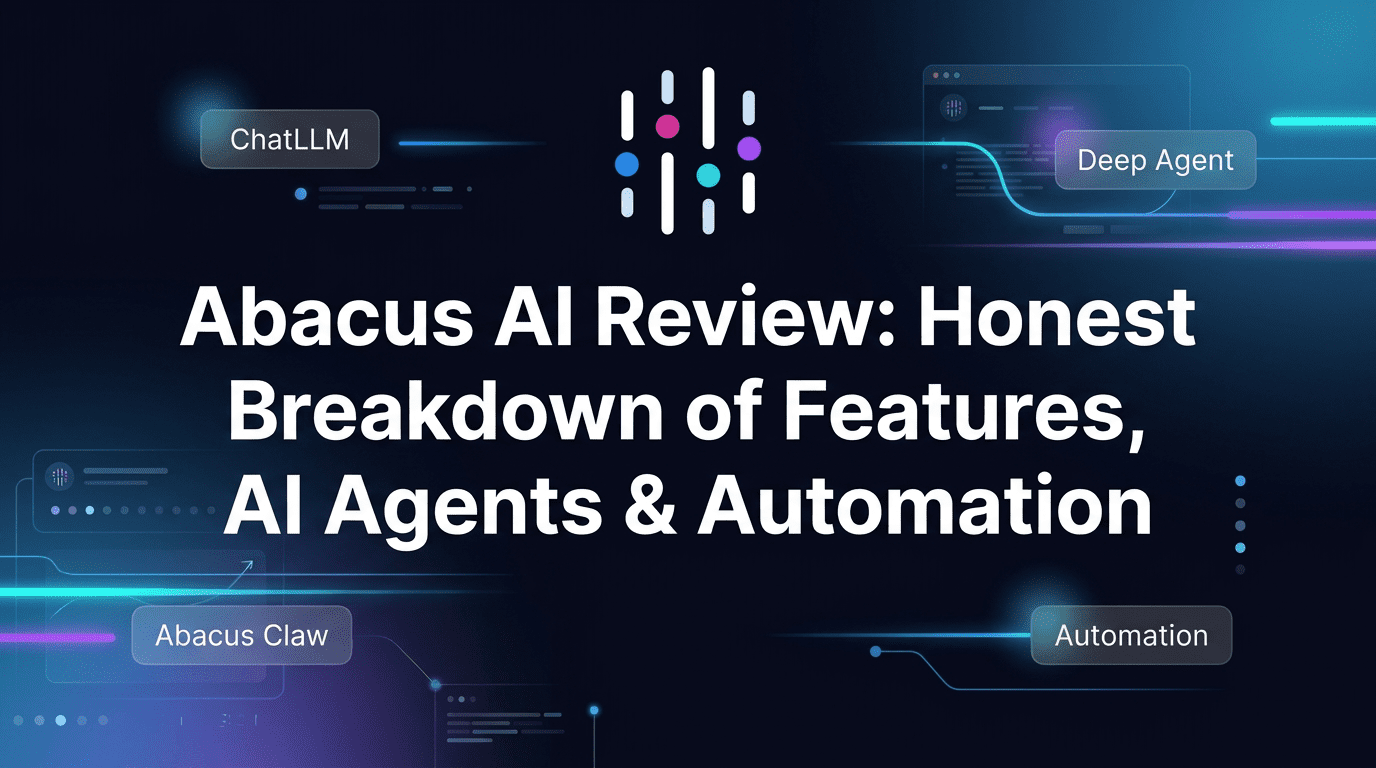
Comprehensive Abacus AI Review: Exploring ChatLLM, AI Agents, Automation, and Advanced App Building Capabilities
This detailed review of Abacus AI examines the platform's comprehensive suite of tools designed for modern artificial intelligence workflows. The analysis covers core features such as ChatLLM and the Abacus AI Agent, alongside specialized tools like Claw. Furthermore, the review explores the platform's capabilities in automation, custom app building, and generative media, including both image and video generation. By evaluating the pricing models, advantages, and potential drawbacks, this guide provides a clear overview of the platform's value proposition. It serves as a resource for organizations and individuals looking to understand the practical applications of Abacus AI and determine its suitability for their specific technical requirements and automation goals.
Key Takeaways
- Comprehensive Feature Set: Abacus AI offers a diverse range of tools including ChatLLM, AI Agents, and the Claw tool for specialized workflows.
- End-to-End Automation: The platform focuses heavily on automation and the ability to build custom AI-driven applications.
- Generative Capabilities: Beyond text, the platform supports both image and video generation, making it a multi-modal solution.
- Balanced Evaluation: The review provides a structured look at pricing, pros, and cons to assist in user decision-making.
In-Depth Analysis
Core Platform Features and AI Agents
Abacus AI positions itself as a robust platform for enterprise-grade AI development. At the heart of its offering is ChatLLM, which provides users with advanced conversational capabilities. This is complemented by the Abacus AI Agent framework, designed to handle complex tasks through autonomous or semi-autonomous workflows. These agents represent a shift toward more interactive and task-oriented AI, allowing users to move beyond simple prompts into structured automation.
Another significant component mentioned is Claw, a tool integrated into the ecosystem to enhance specific technical processes. The synergy between these features suggests a platform built for users who require more than just a standard chatbot, focusing instead on integrated systems that can perform multi-step operations within a single environment.
Automation and Application Development
The platform's strength lies in its focus on automation and app building. Abacus AI provides the infrastructure necessary for users to transition from AI experimentation to full-scale application deployment. This includes tools for building custom applications that leverage the underlying LLM and agent technology. By streamlining the path from development to production, the platform addresses a common bottleneck in the AI industry: the difficulty of integrating AI models into functional, user-facing software.
Furthermore, the inclusion of image and video generation capabilities indicates that Abacus AI is catering to the growing demand for multi-modal content creation. This allows businesses to consolidate their AI needs—ranging from text-based automation to visual content production—under one platform, potentially reducing the complexity of managing multiple disparate AI services.
Strategic Evaluation: Pricing and Usability
A critical aspect of the review involves the assessment of pricing, pros, and cons. For any organization considering an AI platform, the cost-to-benefit ratio is paramount. The review outlines the various pricing tiers to help users understand the financial commitment required. By detailing the 'pros,' such as the breadth of features and automation potential, alongside the 'cons,' the guide provides a realistic perspective on the platform's current state. This balanced approach is essential for determining 'who should use it,' ensuring that potential adopters can match the platform's capabilities with their specific budget and technical expertise.
Industry Impact
The emergence of comprehensive platforms like Abacus AI signifies a maturation in the AI industry. Rather than offering isolated models, companies are now providing integrated environments that combine LLMs, agents, and generative media tools. This trend toward 'all-in-one' AI development platforms lowers the barrier to entry for businesses looking to implement sophisticated automation. By providing tools for app building and multi-modal generation in a single package, Abacus AI challenges other market players to offer more cohesive and versatile solutions, potentially accelerating the adoption of AI agents in mainstream business processes.
Frequently Asked Questions
Question: What are the primary features of Abacus AI mentioned in the review?
The review highlights several key features, including ChatLLM for conversational AI, the Abacus AI Agent for task automation, and the Claw tool. It also covers capabilities for building custom applications and generating both images and videos.
Question: Does the review provide information on the cost of using Abacus AI?
Yes, the review includes a section dedicated to pricing, which is designed to help potential users evaluate the platform's affordability and value based on their specific needs.
Question: Who is the target audience for Abacus AI according to the guide?
The guide includes a specific section on 'who should use it,' which evaluates the platform's pros and cons to help different types of users—ranging from developers to enterprise teams—determine if the tool aligns with their automation and app-building requirements.