NVIDIA CEO Jensen Huang Tells Carnegie Mellon Graduates Their Careers Begin at the Dawn of the AI Revolution
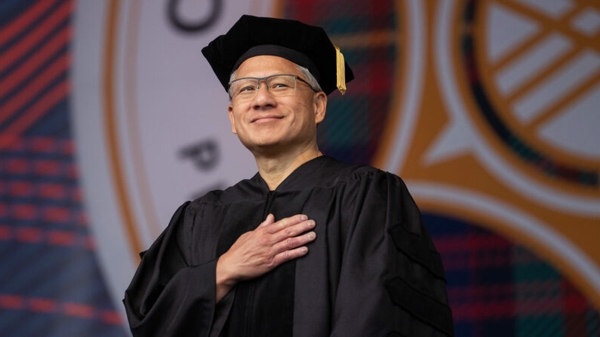
NVIDIA founder and CEO Jensen Huang delivered a powerful commencement address to the Carnegie Mellon University Class of 2026, marking a pivotal moment in the intersection of education and technology. Huang characterized the current era as an 'extraordinary moment' in history, specifically identifying it as the 'beginning of the AI revolution.' Addressing the graduates, he expressed that there has never been a more exciting time to embark on one's life work. The speech highlights the significant role the next generation of professionals will play in shaping the future of artificial intelligence, positioning the Class of 2026 at the forefront of a global technological shift. Huang's message underscores the transformative potential of AI as the defining backdrop for the careers of tomorrow's leaders and innovators.
Key Takeaways
- A Historic Starting Point: NVIDIA CEO Jensen Huang identifies the current period as the definitive 'beginning of the AI revolution,' providing a unique launchpad for new graduates.
- Unprecedented Opportunity: Huang describes the Class of 2026's entry into the professional world as occurring at an 'extraordinary moment' in human history.
- Optimism for the Future: The address emphasizes that the current technological landscape offers the most exciting environment for beginning 'life’s work' compared to previous generations.
- Strategic Venue: The message was delivered at Carnegie Mellon University (CMU), a leading institution in computer science and AI research, reinforcing the link between academic excellence and industry evolution.
In-Depth Analysis
The 'Extraordinary Moment' of 2026
When Jensen Huang addressed the Carnegie Mellon University Class of 2026, his focus was squarely on the timing of their graduation. By labeling this period an "extraordinary moment," Huang is situating the current technological landscape within a broader historical context. For the graduates of 2026, the transition from academia to the professional sphere is not merely a personal milestone but a synchronization with a global shift in how technology functions.
This "moment" is defined by the maturation of artificial intelligence from a specialized field of study into a foundational pillar of the global economy. Huang’s assertion that he "cannot imagine a more exciting time" to begin a career suggests that the tools and platforms available to this specific cohort are fundamentally different—and more powerful—than those available to any previous generation. The convergence of computational power, data availability, and algorithmic sophistication has reached a tipping point that Huang identifies as the true start of a new era.
The AI Revolution as a Professional Foundation
Central to Huang's commencement address is the concept of the "AI Revolution." By stating that the graduates' careers are starting at the "beginning" of this revolution, Huang is framing AI not as a passing trend, but as the primary environment in which all future work will be conducted. This perspective shifts the role of the graduate from a mere participant in the workforce to a pioneer of a new technological frontier.
For the Class of 2026, starting at the "beginning" implies a long-term trajectory where they will be the ones to define the ethics, applications, and boundaries of AI. Huang’s message suggests that the foundational work of the AI era is just starting, and the responsibility for building upon this foundation lies with those entering the field now. This creates a sense of agency for the graduates, implying that their "life’s work" will be synonymous with the evolution of the AI revolution itself.
Industry Impact
Shaping the Future Talent Pipeline
Jensen Huang’s address serves as a significant signal to the broader technology industry regarding the value of new talent. By highlighting the "extraordinary moment" at a prestigious institution like Carnegie Mellon, NVIDIA is reinforcing the importance of high-level academic training in the AI sector. This encourages a tighter integration between industry leaders and academic institutions, ensuring that the next generation of workers is prepared for the specific demands of the AI revolution.
Defining the Narrative of AI Growth
As the CEO of the company at the heart of the AI hardware boom, Huang’s words carry weight in defining the industry's narrative. By framing the current state as the "beginning," he is managing expectations for long-term growth and sustained innovation. This perspective suggests that the industry is not near a peak, but rather at the base of a significant upward curve. For investors, competitors, and partners, this reinforces the idea that the AI transformation is a multi-decadal shift that will define the global economy for the foreseeable future.
Frequently Asked Questions
Question: What did Jensen Huang identify as the current state of the AI industry during his CMU speech?
Answer: Jensen Huang identified the current period as the "beginning of the AI revolution," describing it as an "extraordinary moment" for those starting their careers.
Question: To which graduating class did the NVIDIA CEO deliver this commencement address?
Answer: The address was delivered to the Carnegie Mellon University (CMU) Class of 2026 on May 10, 2026.
Question: Why does Huang believe this is the most exciting time for graduates to start their work?
Answer: Huang believes the timing is unparalleled because the graduates are entering the world at the very start of a major technological revolution, providing them with unique opportunities to shape their life's work within the context of AI.