LongCat-Flash-Prover: Meituan's Open-Source AI Model for Rigorous Mathematical Theorem Proving and Formalization
The Meituan Technical Team has officially released LongCat-Flash-Prover, an open-source AI model specifically engineered for mathematical formalization and theorem proving. This development marks a significant shift in AI mathematical capabilities, moving from simple numerical accuracy to the construction of rigorous logical chains. While traditional AI models often focus on providing the correct final answer to a problem, LongCat-Flash-Prover addresses the more complex challenge of theorem proving, where any ambiguity in natural language can lead to a total collapse of the logical structure. By focusing on formalization, the model aims to transition AI from "guessing answers" to producing verifiable, strict proofs. This open-source contribution provides a specialized tool for the industry to tackle the inherent difficulties of complex reasoning and formal mathematical logic.
Key Takeaways
- Release of LongCat-Flash-Prover: Meituan has open-sourced a specialized model dedicated to mathematical formalization and theorem proving.
- Shift to Rigorous Proof: The model prioritizes strict logical chains over merely achieving the correct final numerical result.
- Addressing Ambiguity: LongCat-Flash-Prover is designed to overcome the failures in reasoning caused by ambiguous natural language in mathematical contexts.
- Open-Source Contribution: The model is made available to the public to advance the field of formal mathematical reasoning and AI development.
In-Depth Analysis
From Numerical Accuracy to Logical Rigor
In the current landscape of artificial intelligence, mathematical problem-solving has largely been defined by the model's ability to reach a correct final value. This "result-oriented" approach, while useful for standard calculations, falls short when applied to the domain of mathematical theorem proving. As highlighted by the Meituan Technical Team, theorem proving requires an entirely different level of precision. It is not enough for a model to simply "calculate correctly"; it must "prove rigorously."
The distinction lies in the structure of the solution. In standard problem-solving, the intermediate steps are often flexible as long as the final output matches the expected value. However, a mathematical proof is a sequence of logical deductions where each step must follow undeniably from the previous ones. LongCat-Flash-Prover is designed to bridge this gap, moving AI capabilities away from the heuristic-based "guessing" of answers toward the systematic construction of formal proofs. This transition is essential for AI to be considered a reliable tool in high-stakes mathematical and scientific research.
The Challenge of Natural Language Ambiguity
A primary obstacle in AI-driven theorem proving is the inherent ambiguity of natural language. In a formal proof, the logic must be airtight. The Meituan Technical Team notes that even a single instance of equivocation or vague phrasing in natural language can cause the entire logical chain of a proof to collapse. This fragility makes theorem proving one of the most challenging tasks in the field of complex reasoning.
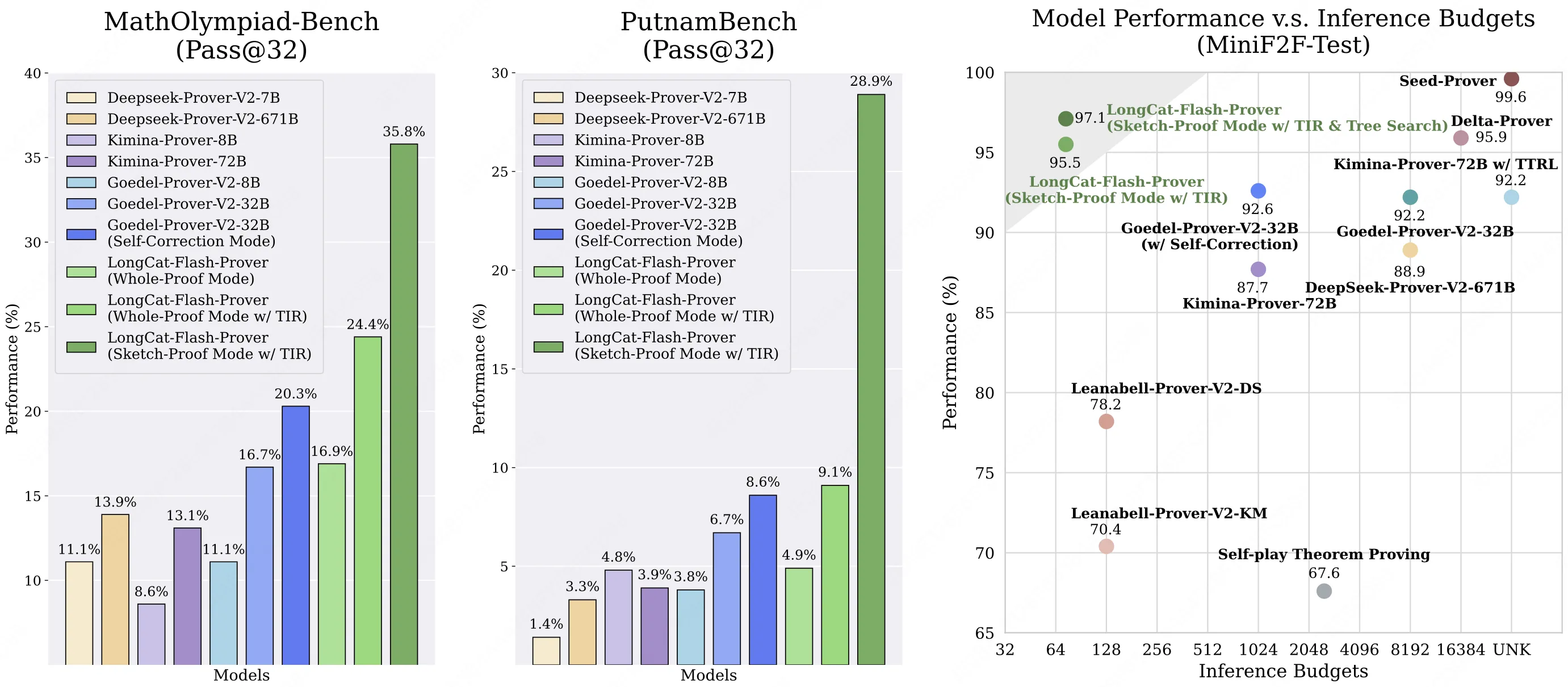
LongCat-Flash-Prover addresses this by focusing on "formalization." Formalization involves translating mathematical concepts into a language that is strictly defined and computationally verifiable. By operating within this framework, the model minimizes the risks associated with the "muddled" nature of standard human language. This focus ensures that the AI does not just mimic the appearance of a proof but adheres to the strict requirements of formal logic, ensuring that every step of the reasoning process is sound and verifiable.
Bridging the Gap in Complex Reasoning
The introduction of LongCat-Flash-Prover represents a targeted effort to solve the problem of "hallucination" or logical inconsistency in AI reasoning. When models "guess" answers, they rely on patterns rather than principles. By providing a model specifically for theorem proving, Meituan is providing a framework where the AI must demonstrate its work through a verifiable formal structure. This is a critical step toward achieving true "reasoning" in artificial intelligence, where the process is as important as the conclusion.
Industry Impact
The release of LongCat-Flash-Prover has significant implications for the AI industry, particularly in the sectors of education, scientific research, and software verification. By open-sourcing this model, Meituan is enabling researchers and developers to build upon a foundation of rigorous formal logic. This could lead to the development of more reliable AI assistants that can assist mathematicians in verifying complex theorems or help computer scientists in formal software verification, where logical errors can have catastrophic consequences.
Furthermore, this move sets a precedent for the importance of formalization in AI. As the industry moves toward more complex reasoning tasks, the ability to prove the correctness of a model's output becomes paramount. LongCat-Flash-Prover provides a specialized toolset that shifts the focus from general-purpose language modeling to specialized, high-precision logical deduction, potentially accelerating breakthroughs in automated reasoning.
Frequently Asked Questions
Question: What is the primary difference between LongCat-Flash-Prover and standard math-solving AI?
Standard math-solving AI models typically focus on reaching the correct final numerical answer. In contrast, LongCat-Flash-Prover is designed for theorem proving, which requires the construction of a strict, formal logical chain where every step must be rigorously proven and verifiable.
Question: Why is natural language a problem for mathematical theorem proving?
Natural language is often ambiguous or "muddled." In the context of a formal mathematical proof, any lack of precision or ambiguity can lead to a logical failure, causing the entire proof to collapse. LongCat-Flash-Prover uses formalization to avoid these pitfalls.
Question: Is LongCat-Flash-Prover available for public use?
Yes, the Meituan Technical Team has open-sourced LongCat-Flash-Prover, making it available for the community to use and develop further in the field of mathematical formalization and theorem proving.