Managing AI-Driven Development: Meituan’s Strategy for Refactoring 310,000 Lines of Code Using Agent Evaluation Logic
Meituan's technical team has shared a comprehensive analysis of their experience refactoring 310,000 lines of code in an environment where over 90% of code is AI-generated. The core insight is that while AI significantly accelerates code production, it can also amplify technical debt and systemic chaos without proper constraints. To mitigate this, the team adopted an 'Agent evaluation' mindset to manage AI coding. By implementing a framework consisting of technical debt sorting, rule construction, standardized operating procedures (SOPs), and a Pre-PR (Pull Request) mechanism, they successfully transformed large-scale refactoring from a high-cost, specialized effort into a continuous, daily iterative process. This approach ensures that AI remains a productive tool rather than a source of unmanaged complexity.
Key Takeaways
- Constraints Over Speed: In an era where 90% of code is AI-generated, the primary challenge shifts from how fast code is written to how effectively AI is constrained by engineering standards.
- Agent Evaluation Logic: Managing AI coding requires a shift toward 'Agent evaluation' thinking, focusing on the systematic assessment of AI outputs rather than just manual oversight.
- Four-Pillar Framework: Successful large-scale refactoring (310,000 lines) relies on technical debt sorting, rule establishment, standardized SOPs, and Pre-PR mechanisms.
- Continuous Iteration: The goal of modern AI management is to turn high-cost refactoring projects into sustainable, daily development tasks.
In-Depth Analysis
The Paradox of AI-Generated Code and Technical Debt
As the software development industry moves toward a reality where the vast majority of code—up to 90% in some cases—is generated by Artificial Intelligence, a new set of challenges emerges. The experience of the Meituan technical team highlights a critical paradox: while AI increases the velocity of code production, it does not inherently improve code quality. Without a unified set of specifications and constraints, AI has the potential to amplify existing chaos and technical debt at an exponential rate. The speed of AI can become a liability if the generated code does not adhere to the long-term architectural goals of the system.
To address this, Meituan's practice suggests that the focus of engineering management must shift. It is no longer enough to simply use AI to write code; teams must build systems that 'constrain' the AI. This involves moving away from viewing AI as a simple autocomplete tool and toward treating it as an 'Agent' that must be evaluated and managed through rigorous technical frameworks.
The Agent Evaluation Framework for AI Coding
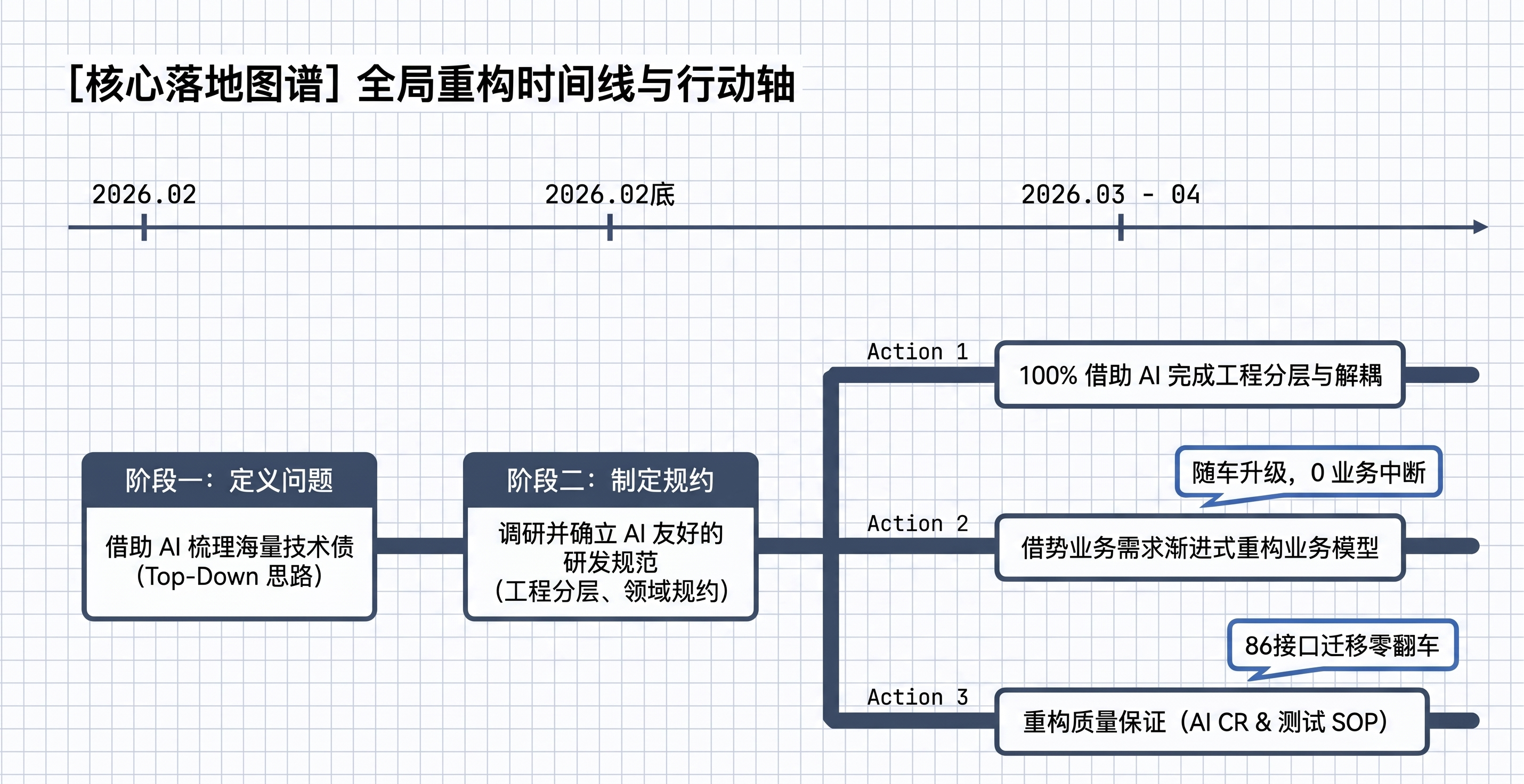
The core of Meituan’s approach to managing 310,000 lines of code refactoring lies in the application of 'Agent evaluation' logic. This methodology treats the AI as an autonomous or semi-autonomous agent whose output must be validated against specific benchmarks and rules. The process is broken down into several critical components:
- Technical Debt Sorting: Before refactoring can begin, there must be a systematic identification of existing technical debt. This ensures that the AI is directed toward the areas of the codebase that require the most attention.
- Rule Construction: Establishing clear, machine-readable rules is essential. These rules serve as the boundaries within which the AI operates, ensuring that the generated code meets the team's standards for maintainability and performance.
- Refactoring SOP (Standard Operating Procedure): By standardizing the refactoring process, the team ensures consistency across the 310,000 lines of code. An SOP provides a predictable path for both human developers and AI agents to follow.
- Pre-PR Mechanism: The implementation of a Pre-PR (Pull Request) mechanism acts as a final gatekeeper. This mechanism evaluates the AI-generated refactoring before it is even submitted for human review, filtering out errors and ensuring compliance with the established rules.
From Special Projects to Daily Iteration
One of the most significant outcomes of this practice is the transformation of the refactoring workflow. Traditionally, refactoring 310,000 lines of code would be viewed as a high-cost, 'special project'—a one-time effort that consumes significant resources and time. However, by using AI and the Agent evaluation framework, Meituan has demonstrated that refactoring can become a 'daily action.'
By integrating these automated constraints and evaluation steps into the standard development lifecycle, the burden of maintaining code quality is distributed across every iteration. This shift allows the system to evolve continuously, preventing the accumulation of massive technical debt that would require disruptive, large-scale interventions in the future. The focus moves from 'fixing the past' to 'continuously optimizing the present.'
Industry Impact
The practices shared by Meituan signal a broader shift in the software engineering industry. As AI becomes the primary author of code, the role of the human developer is evolving from a 'writer' to an 'editor' and 'system architect.' The significance of this transition lies in the necessity of building robust 'meta-systems'—systems that manage the systems writing the code.
For the AI industry, this highlights the growing importance of AI governance and quality assurance tools. The success of large-scale refactoring projects will increasingly depend on the sophistication of the 'evaluation agents' and the rigor of the SOPs that govern them. This case study provides a blueprint for other large-scale technology companies to manage the transition to AI-dominant development environments without sacrificing system stability or long-term maintainability.
Frequently Asked Questions
Question: Why is AI-generated code considered a risk for technical debt?
AI can generate code much faster than humans can review it. If the AI is not guided by strict architectural rules and unified specifications, it may produce code that is inconsistent, redundant, or poorly structured, thereby magnifying the existing complexity and 'chaos' within a large codebase.
Question: What is the benefit of a Pre-PR mechanism in AI coding?
A Pre-PR mechanism serves as an automated quality gate. It evaluates AI-generated code against predefined rules and standards before a human developer ever sees the Pull Request. This reduces the manual review burden and ensures that only code meeting a certain quality threshold enters the main repository.
Question: How does 'Agent evaluation' differ from traditional code review?
Traditional code review is often a manual, human-centric process focused on individual changes. 'Agent evaluation' logic involves building automated systems and frameworks (like rules and SOPs) that treat the AI as an agent. The focus is on systematically measuring and constraining the AI's output based on technical debt assessments and standardized engineering requirements.