Meituan BI Evolution: Leveraging Metric Platforms and Enhanced Computing for Data Consistency and Performance
Meituan's data platform team has introduced a next-generation Business Intelligence (BI) architecture centered on a unified metric platform. This strategic shift addresses critical challenges inherent in traditional BI models, specifically the data definition discrepancies and poor query performance resulting from fragmented, personalized datasets. By integrating "automatic semantics" and "enhanced computing," Meituan has developed a system that streamlines data interpretation and accelerates processing. This evolution represents a significant step in ensuring data accuracy and operational efficiency within large-scale data environments, providing a robust framework for metric-driven decision-making and solving the long-standing issue of inconsistent data definitions across the organization.
Key Takeaways
- Meituan has transitioned to a new BI architecture centered on a centralized metric platform to ensure data consistency.
- The architecture utilizes "automatic semantics" to resolve inconsistencies in data definitions, often referred to as data "mouth-to-mouth" discrepancies.
- "Enhanced computing" capabilities have been implemented within the analysis engine to significantly improve query performance over traditional methods.
- The new system specifically addresses the limitations of personalized dataset-driven BI, which previously led to data chaos and performance bottlenecks.
In-Depth Analysis
The Challenge of Personalized Datasets in Traditional BI
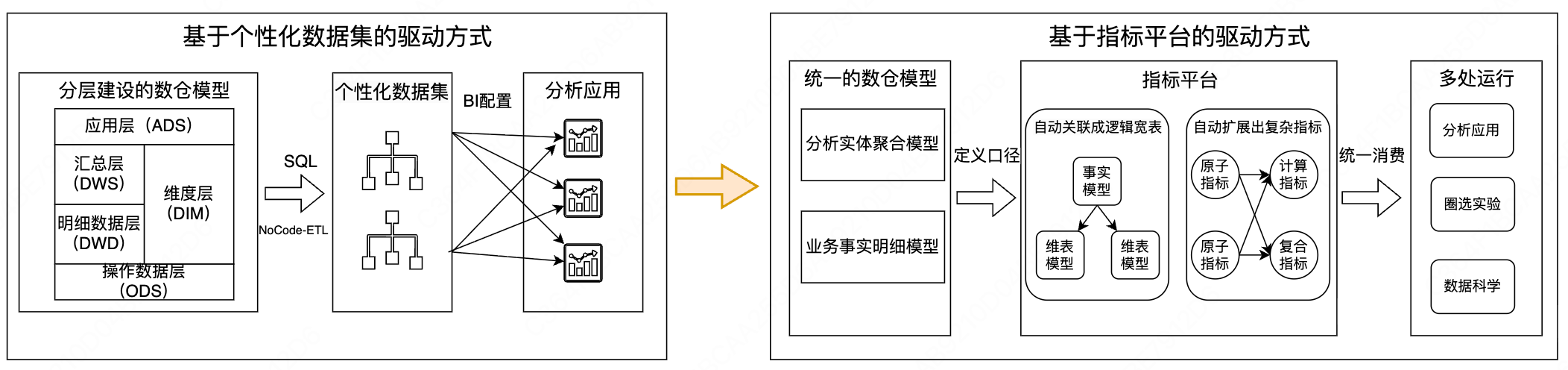
In the traditional Business Intelligence (BI) landscape, many organizations, including Meituan, relied heavily on personalized dataset-driven models. While this approach offered flexibility for individual users to create custom reports, it introduced significant structural weaknesses. The primary issue identified by the Meituan data platform team was the resulting confusion in data "mouth-to-mouth" (口径) or definitions. Because datasets were created in silos, different departments or individuals often applied different logic to calculate the same business metrics. This lack of a unified standard led to conflicting reports and a lack of trust in data-driven insights. Furthermore, as these personalized datasets proliferated, the underlying analysis engines struggled to maintain efficiency, leading to degraded query performance that hindered timely decision-making.
The Metric Platform as a Unified Solution
To combat these challenges, Meituan has constructed a new generation BI architecture that places a metric platform at its core. This shift represents a move away from fragmented data management toward a centralized governance model. By defining metrics at the platform level rather than the dataset level, Meituan ensures that every part of the organization uses the same logic for key performance indicators. This centralized approach acts as a "single source of truth," effectively eliminating the discrepancies caused by personalized dataset creation. The metric platform serves as the foundational layer that feeds consistent data to various analysis tools and visualization engines across the company.
Technical Pillars: Automatic Semantics and Enhanced Computing
The success of Meituan's new BI architecture rests on two core technical capabilities: automatic semantics and enhanced computing.
Automatic Semantics is the primary tool used to solve the problem of inconsistent data definitions. In a complex data environment, manual mapping of business logic to technical data fields is prone to error. Automatic semantics allows the system to intelligently interpret and apply the correct business logic to the data, ensuring that the "mouth-to-mouth" definition remains constant regardless of who is performing the query. This automation reduces the manual overhead of data preparation and minimizes the risk of human error in metric calculation.
Enhanced Computing focuses on the performance aspect of the analysis engine. One of the critical failures of traditional BI platforms is the inability to handle large-scale, complex queries with high speed. Meituan's investment in enhanced computing capabilities allows the analysis engine to process vast amounts of data more efficiently. This ensures that even as the complexity of business questions grows, the BI platform can deliver results quickly, maintaining a high level of user engagement and operational agility. Together, these two capabilities transform the BI platform from a simple reporting tool into a high-performance analytical engine.
Industry Impact
Meituan's exploration into metric platforms and analysis engines reflects a broader trend in the data industry toward the decoupling of metrics from visualization. This approach, often associated with the concept of a "Headless BI" or a "Semantic Layer," is becoming essential for large-scale enterprises that require high data integrity. By successfully implementing automatic semantics and enhanced computing, Meituan provides a blueprint for how technical teams can resolve the tension between user flexibility and data consistency. For the wider AI and data industry, this practice highlights the necessity of robust data infrastructure to support advanced analytics and automated decision-making systems, ensuring that the data feeding these systems is both accurate and performant.
Frequently Asked Questions
Question: What were the main problems Meituan faced with traditional BI platforms?
Traditional BI platforms at Meituan suffered from inconsistent data definitions (data mouth-to-mouth confusion) and poor query performance. These issues were primarily driven by the use of personalized datasets, which lacked centralized governance and led to fragmented, conflicting data logic across different reports.
Question: How does the metric platform address data definition confusion?
The metric platform addresses this by using "automatic semantics." This capability ensures that business metrics are defined and interpreted consistently across the entire organization. By centralizing the logic within the platform, it prevents different users from applying different calculation methods to the same metric.
Question: What role does "enhanced computing" play in Meituan's new architecture?
"Enhanced computing" is a core capability of the analysis engine designed to solve the query performance issues common in traditional BI setups. It optimizes how data is processed and retrieved, allowing the platform to handle large-scale data analysis tasks with significantly higher speed and efficiency.