
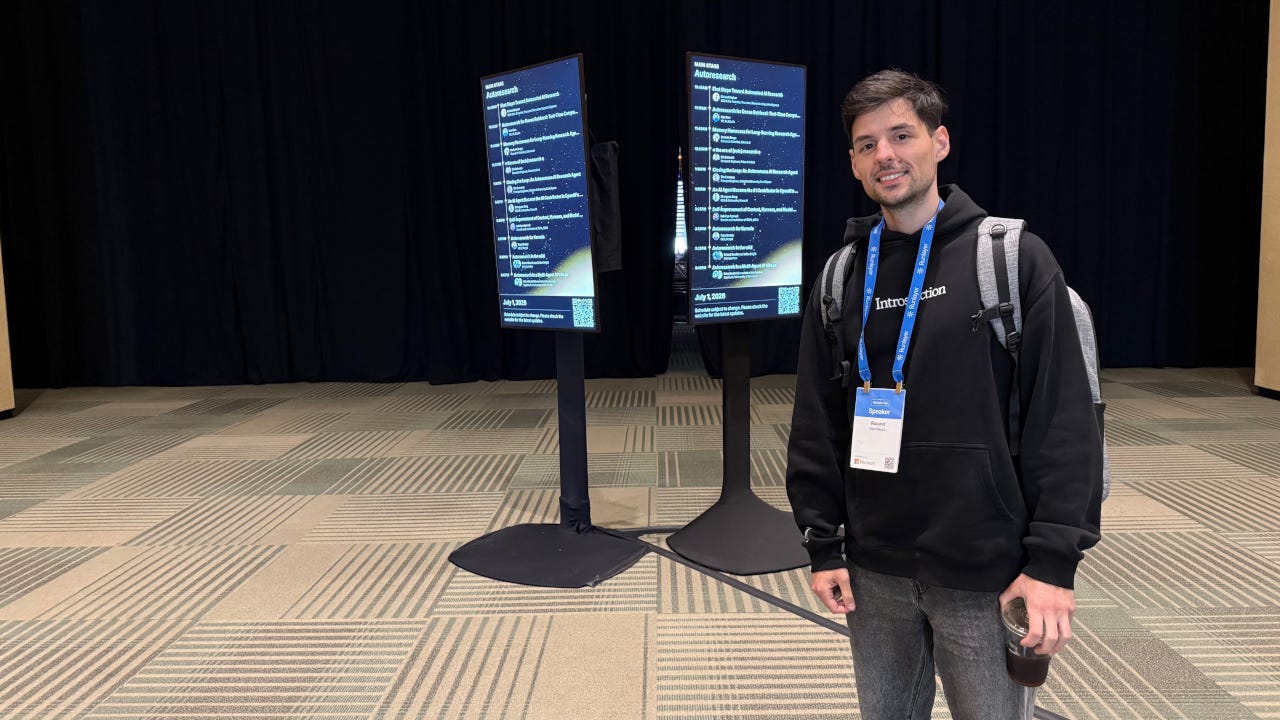
Understanding Autoresearch and the Feedback Loop Behind Self-Improving AI Agents with Introspection Co-Founder Roland Gavrilescu
In a recent discussion, Roland Gavrilescu, the co-founder of Introspection, detailed the emerging paradigm of "autoresearch" and its role in the development of self-improving AI agents. The conversation highlights the technical framework of agent "recipes" and the implementation of self-improving loops that allow AI systems to refine their performance over time. A significant portion of the analysis focuses on the concept of the "software factory," where automation and AI-driven processes are becoming standard. Despite the high level of automation discussed, Gavrilescu emphasizes that humans remain a central and indispensable part of this software factory, providing the necessary oversight and direction for these self-improving systems. This insight provides a glimpse into the future of autonomous software development and the evolving relationship between human engineers and intelligent agents.
Key Takeaways
- Autoresearch Defined: Autoresearch is presented as a fundamental feedback loop mechanism that enables the creation and refinement of self-improving AI agents.
- The Role of Agent Recipes: The development process utilizes specific "recipes" to structure agent behavior and facilitate consistent improvement cycles.
- Human-Centric Automation: Despite the move toward a "software factory" model, human involvement remains a core component of the development and oversight process.
- Self-Improving Loops: The integration of self-improving loops allows agents to introspect and enhance their own operational capabilities through iterative feedback.
In-Depth Analysis
The Mechanics of Autoresearch and Agent Recipes
At the heart of modern AI agent development lies the concept of "autoresearch." According to Roland Gavrilescu, co-founder of Introspection, autoresearch functions as a critical feedback loop that drives the evolution of self-improving agents. This process is not merely about automated execution but involves a sophisticated cycle where agents analyze their own performance to identify areas for optimization. By implementing these feedback loops, developers can create systems that learn from their successes and failures in a structured manner.
Central to this methodology is the use of agent "recipes." These recipes serve as the architectural blueprints for agent behavior, defining the parameters and logic that govern how an agent interacts with data and tasks. By utilizing these standardized recipes, the autoresearch process can more effectively test variations and improvements, leading to a more streamlined path toward high-functioning, autonomous agents. This structured approach to agent development ensures that the self-improvement process is both measurable and directed toward specific performance goals.
The Software Factory and the Human Element
The concept of the "software factory" represents a shift toward highly automated, industrial-scale software production powered by AI agents. In this model, the creation, testing, and deployment of code are increasingly handled by self-improving loops. However, Gavrilescu points out a vital distinction in this trend: the continued centrality of the human element. While the agents handle the repetitive and iterative aspects of research and development, humans are responsible for the high-level design, ethical considerations, and strategic direction of the factory.
This human-centrality ensures that the self-improving loops do not drift away from the intended utility or safety standards. In the context of Introspection's work, the software factory is not a fully autonomous entity but rather a collaborative environment where human expertise guides the AI's autoresearch capabilities. This synergy between human intuition and machine efficiency is what allows the software factory to produce complex, reliable software at a pace that was previously unattainable. The feedback loop, therefore, includes human feedback as a primary signal for the agent's self-improvement journey.
Industry Impact
The introduction of autoresearch and self-improving loops marks a significant milestone in the AI industry. By moving away from static models and toward agents that can actively participate in their own development, the industry is entering an era of dynamic software engineering. This shift has profound implications for how AI companies approach research and development, suggesting that the next generation of breakthroughs will come from the systems that are best at improving themselves.
Furthermore, the emphasis on the human role within the software factory provides a roadmap for future workforce integration. It suggests that as AI agents become more capable of performing complex research tasks, the role of the human developer will shift toward orchestration and oversight. This model of "human-in-the-loop" automation is likely to become the standard for high-stakes AI applications, ensuring that self-improving systems remain aligned with human goals and values.
Frequently Asked Questions
Question: What is the primary function of autoresearch in AI development?
Autoresearch acts as a feedback loop that allows AI agents to engage in a self-improvement process. It involves the agent analyzing its own performance and utilizing structured "recipes" to iteratively enhance its capabilities and efficiency.
Question: How do agent "recipes" contribute to the self-improvement process?
Agent recipes provide the necessary structure and blueprints for how an agent should operate. By having a defined recipe, the autoresearch feedback loop can systematically test and refine different components of the agent's logic, leading to more predictable and effective improvements.
Question: Why does Roland Gavrilescu believe humans remain central to the software factory?
Despite the advancements in automation and self-improving agents, humans are essential for providing strategic direction, high-level decision-making, and oversight. Humans ensure that the automated processes within the software factory remain aligned with complex objectives and safety standards that AI cannot yet manage independently.

