Harbor favicon

Harbor

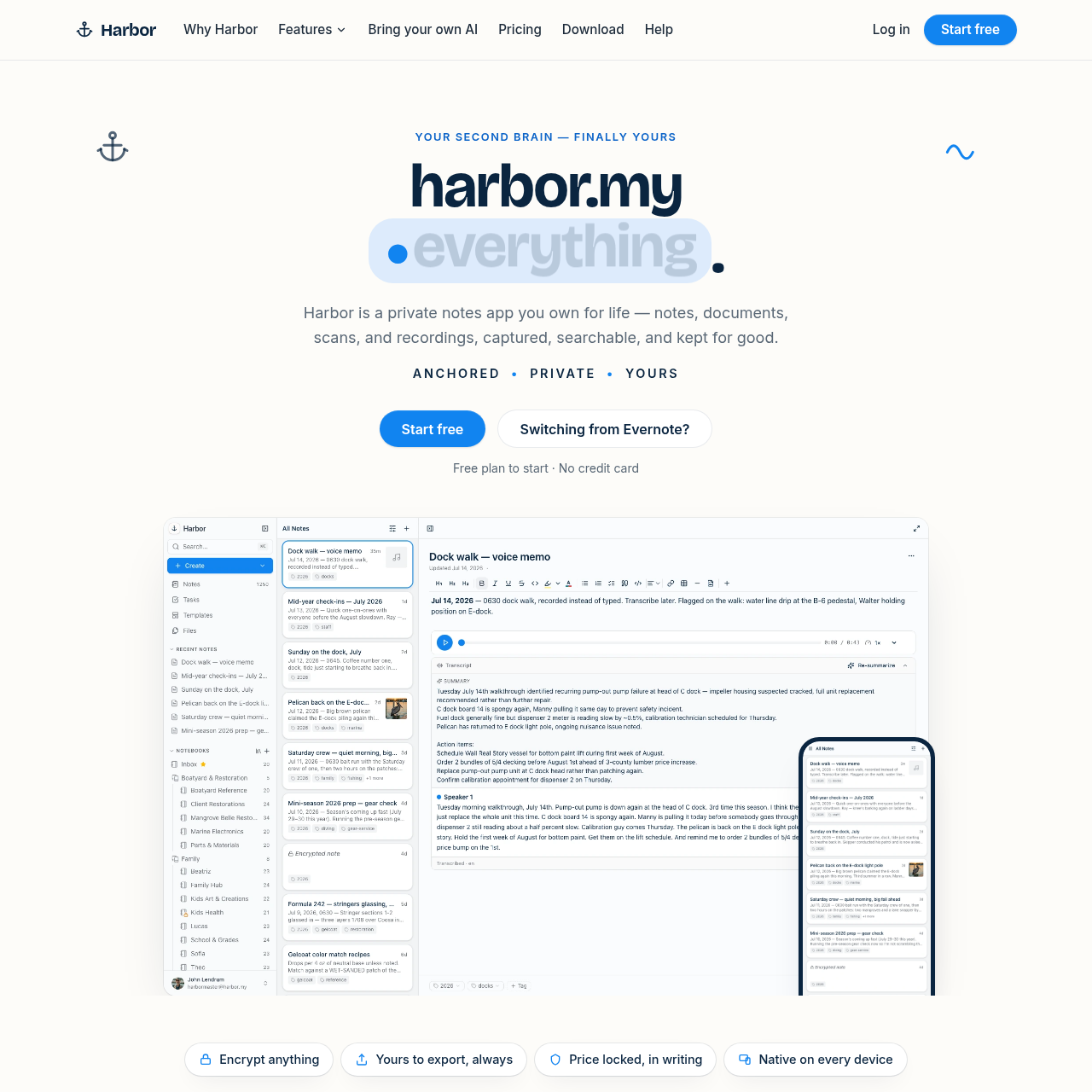
Harbor is a private, cross-platform note-taking app offering optical character recognition, offline-capable native clients, granular zero-knowledge encryption, and developer endpoints to connect external AI models.

ProductivitySearching text inside scanned PDFs,…Transcribing audio recordings into…Applying zero-knowledge encryption…Syncing notes across native desktop,…
Harbor product interface screenshot
Listed on AIToolly

What Is Harbor? Product Overview

What the product does and how it is positioned

Harbor is a personal knowledge management and note-taking platform designed to capture notes, scanned documents, audio recordings, handwriting, and web clips in one central repository. It provides native clients across desktop and mobile platforms that function offline and sync changes when connectivity is restored.

The service avoids hosting built-in AI models, instead providing API, CLI, and Model Context Protocol interfaces so users can connect their own external tools and models. Security features include optional zero-knowledge encryption for designated notes alongside full data export and Evernote import capabilities.

What Can You Use Harbor For?

Source-supported ways to use the product

Document and Receipt Archiving

Users capture physical receipts, invoices, and documents through scans or photos, relying on built-in optical character recognition to search and retrieve text stored within images and PDF files.

Browser Research Collection

Researchers and writers use browser extensions across major web browsers to clip full web pages, simplified articles, or annotated screenshots directly into targeted notebooks.

External AI-Assisted Note Organization

Developers and knowledge workers integrate their personal ChatGPT, Claude, or Cursor accounts via API, CLI, or MCP to search, create, and organize notes without sharing unencrypted private notebooks.

Bring Your Own AI Integration Model

Harbor diverges from conventional note-taking applications by deliberately omitting a built-in proprietary artificial intelligence system. Instead, the platform provides open integration touchpoints, enabling users to bridge external AI models and workflows into their personal note repository.

Through standard API endpoints, a command-line interface, and the Model Context Protocol, users can authenticate using their own developer keys to index, search, add, and restructure notebooks using external systems such as ChatGPT, Claude, or Cursor.

This architecture maintains user authority over AI access permissions. Because encrypted notes remain inaccessible without the user's private key, users control which materials remain isolated and which are exposed to external automated tools.

  • Connects to user-supplied AI models through API, CLI, and MCP protocols
  • Permits credential revocation and API access management at any time
  • Restricts external AI processing to unencrypted notes to protect sensitive data

What to Test Before Choosing Harbor

Checks to run with your own material and workflow

  • Confirm that the native desktop and mobile applications operate as expected during offline workflows.
  • Verify the accuracy of optical character recognition when indexing handwritten notes, photos, and scanned PDFs.
  • Check whether zero-knowledge encryption functions properly on select notes while leaving general notebooks accessible for search.
  • Review the setup process and connectivity of the API, CLI, or MCP endpoints with external AI tools such as Claude or ChatGPT.
  • Verify the Evernote import tool correctly migrates tags, notebooks, attachments, and clips without data loss.

Harbor Sources and Last Checked

What was checked and when

Official source
https://harbor.my/
Last checked
Category
Productivity

Harbor Frequently Asked Questions

Answers based on the source-checked product record

Does Harbor include built-in AI features?

Harbor does not include a proprietary native AI assistant. Instead, it provides an API, CLI, and Model Context Protocol support so users can connect third-party AI models like ChatGPT or Claude using their own API keys.

Can Harbor search text within images and handwritten documents?

Yes, Harbor includes optical character recognition that reads and indexes printed words in scanned PDFs and photos, text in handwriting, and automatically generates searchable transcripts from audio recordings.

How does encryption work in Harbor?

Users can selectively enable zero-knowledge encryption on specific individual notes or entire notebooks. When enabled, only the user holds the decryption key, though encrypted notes cannot be indexed for global search or processed by external AI tools.

Which operating systems and browsers are supported?

Harbor provides native applications for Mac, Windows, iPhone, iPad, and Android, as well as a web app. Its Web Clipper extension supports Chrome, Edge, Firefox, and Safari.

What happens if a user decides to stop using Harbor?

Harbor allows users to export all of their data at any time through standard file exports or via its API, CLI, and MCP developer interfaces, supporting notes and attachments can be transferred elsewhere.

Explore other recently added tools in the same category.