
Meituan Technical Team Unveils AI Agent Evaluation White Paper Series to Standardize Practical System Implementations
The Meituan Technical Team has officially launched a specialized four-part blog series titled the Agent Evaluation White Paper, designed to deliver a systematic, end-to-end operational guide for evaluating artificial intelligence agents in production settings. The first installment in the series, titled Evaluation Overview, establishes the architectural foundation for measuring agentic performance across real-world workflows. Moving beyond abstract methodologies, the complete series comprises four dedicated sections: Evaluation Overview, Cold Start, Scaling, and Self-Evolution. By structuring the evaluation lifecycle into sequential, actionable engineering stages, the white paper addresses the critical industry challenge of quantifying agent efficacy, stability, and growth. This publication provides developers, researchers, and technical leaders with an authoritative reference framework for validating complex AI agents from initial deployment through large-scale autonomous operation.
Key Takeaways
- Systematic Publication Series: Meituan's technical team has introduced a four-part technical publication series titled the Agent Evaluation White Paper, focusing entirely on practical implementation guidelines for AI agent evaluation.
- Sequential Four-Stage Structure: The complete framework is methodically divided into four distinct phases: Evaluation Overview, Cold Start, Scaling, and Self-Evolution.
- Inaugural Release: The initial article, Evaluation Overview, serves as the foundational cornerstone of the entire series, outlining systematic evaluation methodologies for complex AI systems.
- Focus on Operational Reality: The series emphasizes real-world engineering adoption, targeting the specific lifecycle phases required to evaluate, scale, and continuously evolve AI agents.
In-Depth Analysis
A Four-Part Systematic Evaluation Framework
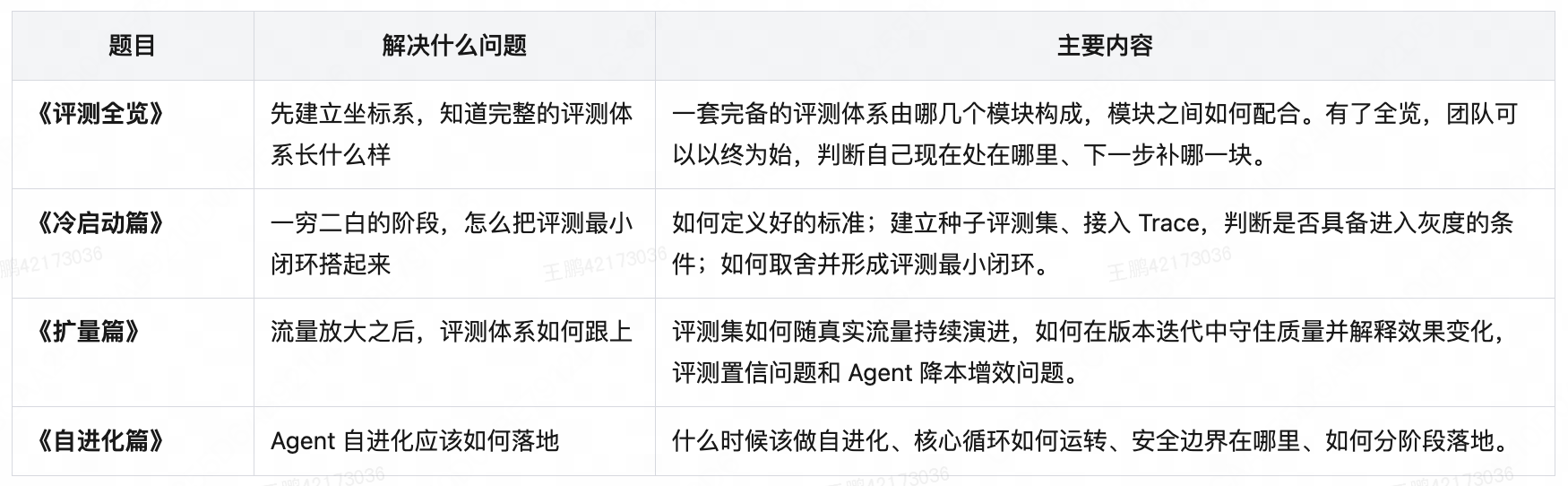
As artificial intelligence transitions from standalone large language models toward agentic workflows, assessing the performance of autonomous agents has emerged as one of the most critical engineering challenges. Addressing this technical frontier, the Meituan Technical Team has announced the release of its comprehensive Agent Evaluation White Paper blog series. Rather than treating agent assessment as an isolated offline benchmarking exercise, the technical team has structured its guidance into a cohesive, four-part curriculum consisting of Evaluation Overview (评测全览), Cold Start (冷启动篇), Scaling (扩量篇), and Self-Evolution (自进化篇).
This structured architecture reflects the real-world operational journey of engineering teams deploying agentic AI. By explicitly establishing four progressive milestones, the framework provides a transparent roadmap for software architects and machine learning engineers. Each volume is designed to systematically dissect the specific evaluation hurdles encountered at distinct stages of agent maturity, transforming fragmented evaluation techniques into an overarching, repeatable engineering discipline.
Unpacking the Inaugural Release: Evaluation Overview
Serving as the flagship publication of the series, the first installment—Evaluation Overview—lays the systemic groundwork for assessing modern AI agents. Unlike standard foundation model benchmarks that assess static next-token prediction or isolated question-answering accuracy, evaluating an autonomous agent requires measuring an interconnected system comprised of base models, planning modules, external tool integrations, and operational environments.
In this foundational release, Meituan focuses on synthesizing the macro-level methodology required to evaluate agents rigorously. The publication establishes the baseline definitions, conceptual guardrails, and systematic perspectives essential for understanding how agents perform when tasked with dynamic, multi-turn challenges. By demystifying the core components of agent evaluation upfront, Evaluation Overview prepares technical teams to navigate the subsequent, more granular engineering phases of the deployment lifecycle.
Navigating the Lifecycle: From Cold Start to Self-Evolution
While the first post anchors the macro framework, the remaining three titles revealed in Meituan's roadmap articulate a coherent progression through the standard software and model development lifecycle:
- Cold Start (冷启动篇): The second installment targets the zero-to-one phase of agent development. During cold start, teams frequently face a lack of historical interaction data, uncertain baseline behaviors, and high testing costs. Evaluation at this juncture focuses on establishing initial test beds, creating representative task sets, and determining whether an agent meets minimum viability before exposure to production environments.
- Scaling (扩量篇): Once an agent functions in constrained conditions, teams encounter the complexities of scale. The third installment addresses how evaluation paradigms must transform when traffic, tool ecosystems, domain complexities, and corner cases multiply. Evaluating for scale requires high-throughput testing pipelines, regression prevention mechanisms, and robust stability metrics.
- Self-Evolution (自进化篇): The culminating phase tackles advanced agent autonomy. As modern agents incorporate continuous feedback loops, dynamic memory retention, and autonomous tool generation, the evaluation system must itself adapt. This segment explores how to monitor, quantify, and govern agents that learn and modify their behaviors over time, ensuring system alignment and performance gains without catastrophic regression.
Industry Impact
Meituan's release of the Agent Evaluation White Paper marks a significant milestone in standardizing engineering practices for autonomous agent deployments. Across the global artificial intelligence landscape, organizations have successfully demonstrated compelling single-purpose agent prototypes; however, transitioning prototypes into reliable, enterprise-grade production systems remains exceptionally difficult. A primary bottleneck has been the absence of standardized, systemic evaluation methodologies tailored to agentic behavior.
By open-sourcing their internal engineering insights through this structured four-part series, Meituan provides industry practitioners with an operational blueprint. The initiative highlights that model evaluation can no longer be decoupled from end-to-end system evaluation. As more enterprises adopt multi-agent orchestration, function calling, and automated workflows, systematic evaluation frameworks like the one outlined by Meituan will become indispensable for setting enterprise quality thresholds, preventing operational failures, and establishing verifiable standards for autonomous AI software.
Frequently Asked Questions
What is the primary purpose of Meituan's Agent Evaluation White Paper series?
The Agent Evaluation White Paper series is designed by the Meituan Technical Team to serve as a systematic, operational implementation guide for evaluating artificial intelligence agents, providing a comprehensive framework that spans from initial setup through long-term autonomous evolution.
What are the four core sections included in the white paper?
The series is organized into four distinct parts: Evaluation Overview (Part 1), Cold Start (Part 2), Scaling (Part 3), and Self-Evolution (Part 4).
Who is the primary target audience for this technical series?
The series is tailored for technical professionals, including AI system architects, machine learning engineers, software developers, and technical leaders responsible for building, testing, validating, and scaling AI agents in production environments.


