Back to List
ReasoningBank: Google Research Explores New Methods for Enabling AI Agents to Learn from Experience
Research BreakthroughGoogle ResearchGenerative AIAI Agents

ReasoningBank: Google Research Explores New Methods for Enabling AI Agents to Learn from Experience

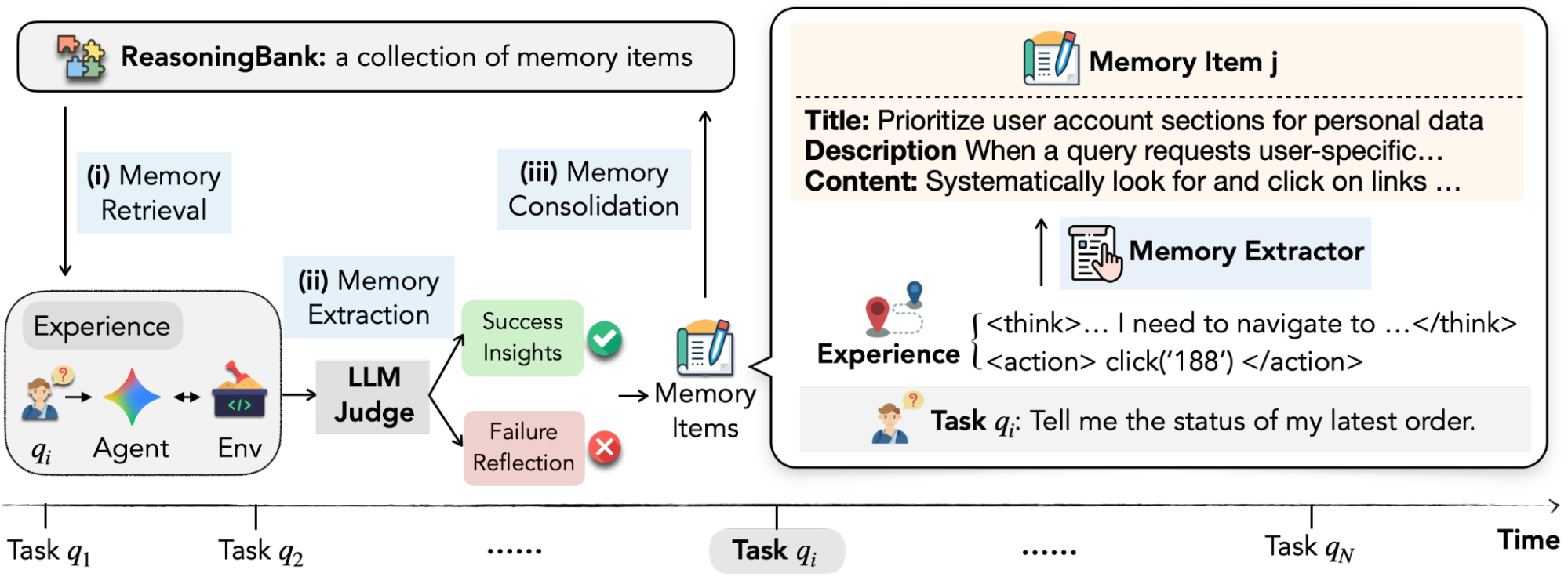
Google Research has introduced ReasoningBank, a development focused on the evolution of generative AI agents. According to the publication, this initiative aims to enable agents to learn more effectively from their experiences. While the specific technical architecture and detailed performance metrics remain within the scope of Google Research's broader generative AI initiatives, the announcement highlights a shift toward more autonomous learning capabilities in artificial intelligence. This development represents a significant step in the field of generative AI, focusing on how agents can refine their reasoning processes over time. The project underscores Google's ongoing commitment to advancing the boundaries of how AI systems interact with and learn from the data and environments they encounter.

Google Research Blog

Key Takeaways

  • Google Research has announced ReasoningBank, a project centered on generative AI.
  • The primary focus of the initiative is enabling AI agents to learn from experience.
  • The project is part of Google's broader research into advancing generative AI capabilities.

In-Depth Analysis

Advancing Generative AI through Experience

ReasoningBank represents a strategic focus by Google Research into the field of generative AI. The core objective of this initiative is to bridge the gap between static model responses and dynamic learning. By focusing on how agents learn from experience, the research suggests a move toward AI systems that do not just process information but adapt based on previous interactions and outcomes.

The Role of Reasoning in AI Agents

The title 'ReasoningBank' implies a repository or a structured framework for reasoning processes. In the context of generative AI, this suggests that Google is looking for ways to make AI agents more reliable and capable of complex task execution. By enabling these agents to learn from their past actions, the research aims to improve the overall efficiency and intelligence of autonomous systems.

Industry Impact

The introduction of ReasoningBank by Google Research signals a significant trend in the AI industry toward 'experiential learning' for models. If agents can successfully learn from experience, the industry may see a reduction in the need for constant manual fine-tuning. This could lead to more robust AI applications in various sectors, where agents become more proficient the more they are utilized, ultimately setting a new standard for generative AI development.

Frequently Asked Questions

Question: What is the main goal of ReasoningBank?

ReasoningBank is designed to enable generative AI agents to learn from their experiences, improving their reasoning and performance over time.

Question: Who is the organization behind this research?

The project is being developed and was published by Google Research.

Question: How does this relate to generative AI?

ReasoningBank is a specific application or framework within the generative AI field that focuses on the learning and reasoning capabilities of AI agents.
Related News

Meituan Showcases AI Innovation at ACL 2026 with Six Papers on Large Model Evaluation and Reasoning Optimization
Research Breakthrough

Meituan Showcases AI Innovation at ACL 2026 with Six Papers on Large Model Evaluation and Reasoning Optimization

Meituan's technical team has achieved significant recognition at ACL 2026, a premier international conference for computational linguistics and natural language processing. The team had six papers accepted, covering a broad spectrum of cutting-edge AI research. These papers delve into critical areas such as large-scale model evaluation, complex process reasoning, and the optimization of competition-level mathematical thinking. Additionally, the research explores advancements in reinforcement learning and generative recommendation systems. This selection highlights Meituan's commitment to building a new paradigm for generative AI, focusing on both theoretical depth and practical application within the NLP domain. The accepted works represent a comprehensive approach to enhancing the intelligence and reliability of modern AI systems.

LARYBench Launch: Defining the ImageNet for Embodied Action Representation and Measuring Generalization from Human Video Data
Research Breakthrough

LARYBench Launch: Defining the ImageNet for Embodied Action Representation and Measuring Generalization from Human Video Data

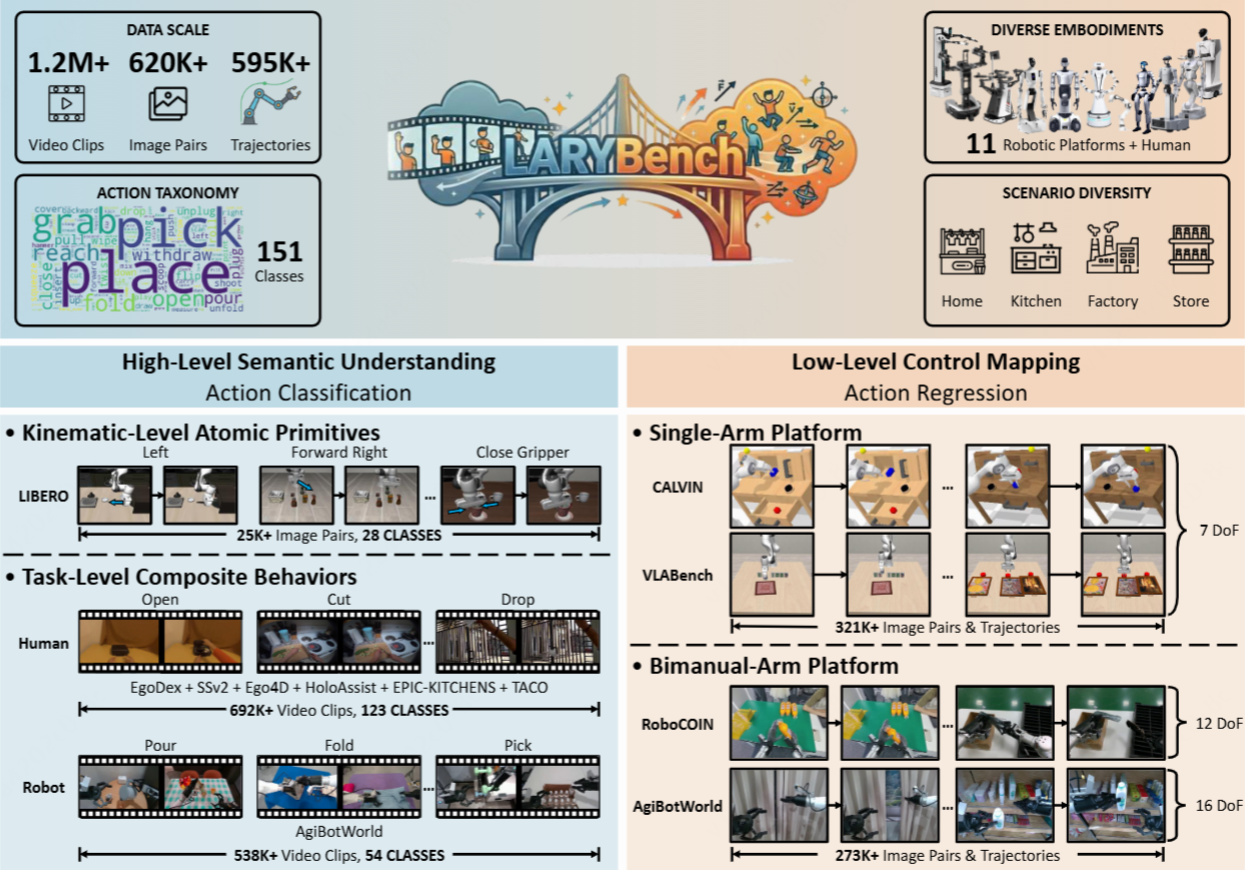
The Meituan Technology Team has officially introduced LARYBench (Latent Action Representation Yielding Benchmark), a systematic evaluation framework designed to guide the learning of general latent action representations from large-scale visual data. This benchmark represents a significant milestone in the field of embodied AI, often compared to the 'ImageNet' moment for action representation. Experimental results provided by the team indicate that general vision models significantly outperform specialized embodied AI expert models in both action generalization and control precision. Crucially, the research demonstrates that embodied action representations can emerge naturally from extensive human video datasets, offering a new methodology for training robotic systems without relying solely on specialized, task-specific data.

Meituan LongCat Team Launches LongCat-AudioDiT to Redefine Zero-Shot TTS Voice Cloning Limits
Research Breakthrough

Meituan LongCat Team Launches LongCat-AudioDiT to Redefine Zero-Shot TTS Voice Cloning Limits

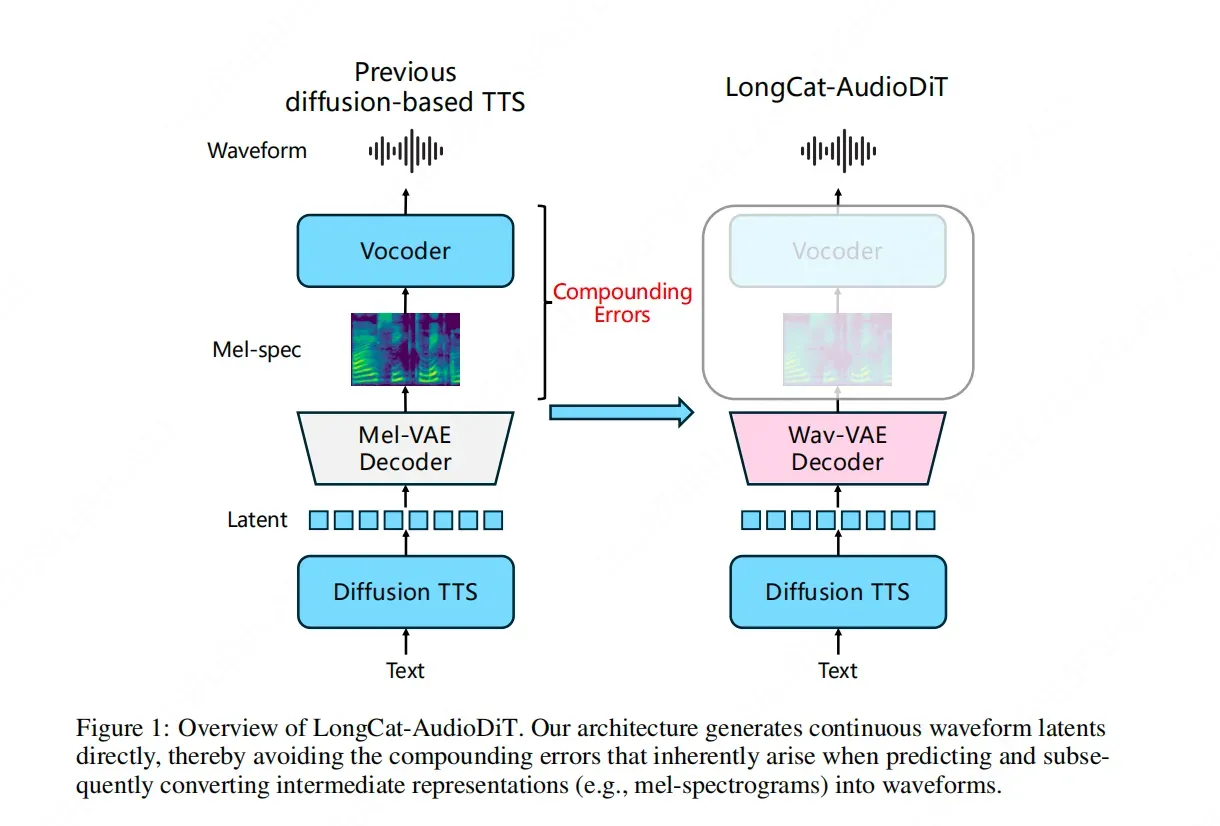
The Meituan LongCat team has officially unveiled LongCat-AudioDiT, a revolutionary Text-to-Speech (TTS) model designed to push the boundaries of zero-shot voice cloning. By fundamentally altering the synthesis pipeline, the model abandons traditional intermediate representations such as Mel-spectrograms. Instead, it operates directly within the waveform latent space using a diffusion-based framework. This strategic shift is intended to eliminate the cascade errors typically caused by multiple stages of data conversion. By allowing the AI to learn the inherent patterns and laws of sound directly, LongCat-AudioDiT aims to provide a more seamless and authentic voice cloning experience, addressing long-standing technical bottlenecks in the field of audio synthesis and zero-shot learning.