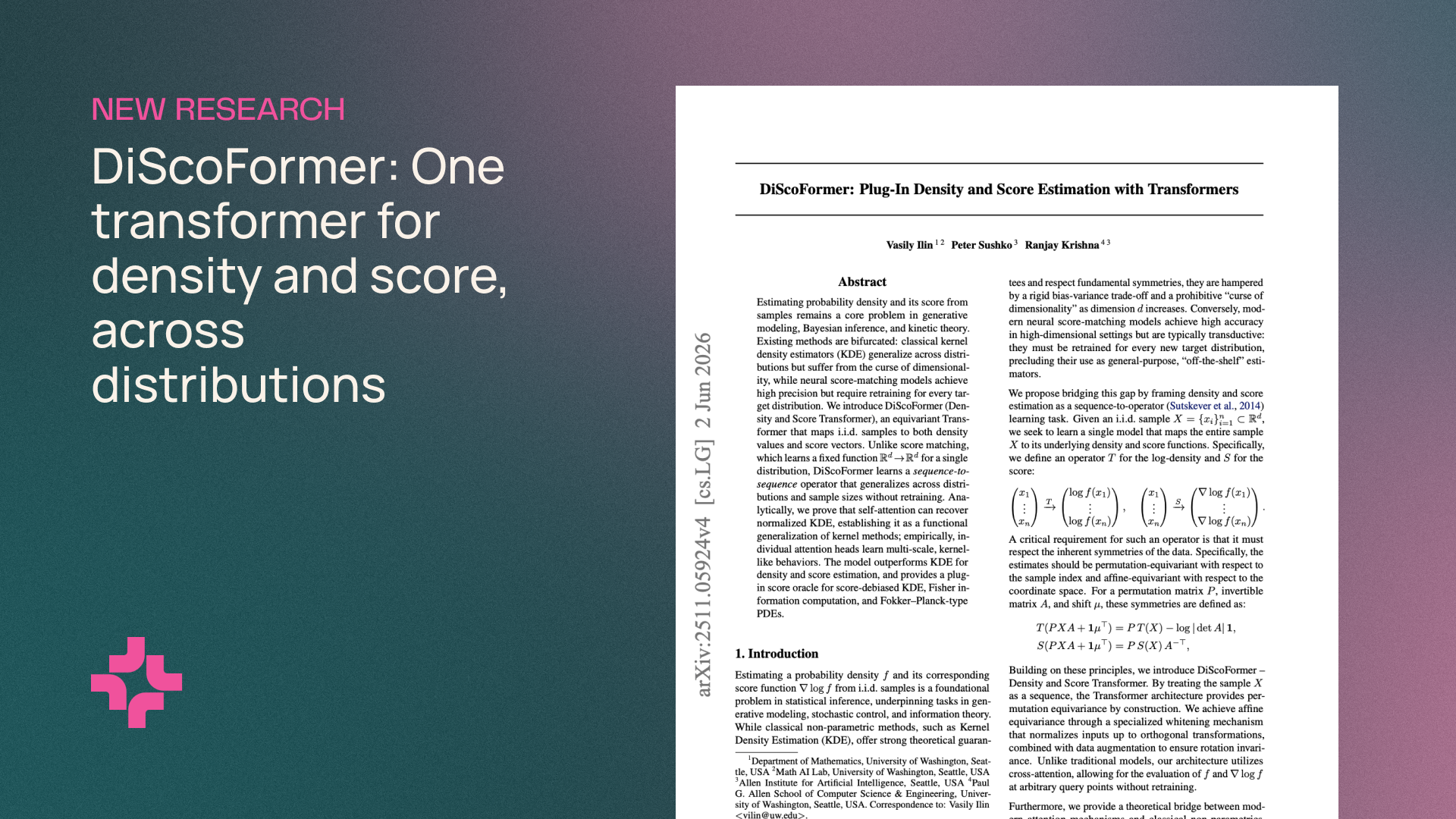
DiScoFormer: AllenAI Introduces a Unified Transformer for Density and Score Estimation Across Distributions
AllenAI has announced the development of DiScoFormer, a novel transformer architecture designed to unify density and score estimation within a single model. Published on the Hugging Face Blog on June 29, 2026, this research marks a significant step in generative modeling by enabling a single transformer to operate across various distributions. The project, a collaboration involving AllenAI, focuses on the dual capabilities of density (likelihood-based) and score (gradient-based) estimation. By bridging these two fundamental approaches to probabilistic modeling, DiScoFormer aims to provide a more versatile framework for AI researchers and developers working with complex data distributions. While specific performance metrics were not detailed in the initial announcement, the model's ability to handle both tasks simultaneously suggests a move toward more efficient and integrated AI architectures.
Key Takeaways
- Unified Architecture: DiScoFormer introduces a single transformer model capable of performing both density and score estimation.
- Cross-Distribution Versatility: The model is designed to function effectively across a wide range of data distributions.
- AllenAI Innovation: Developed by AllenAI and shared via the Hugging Face platform, emphasizing open-source research contributions.
- Dual Modeling Approach: Integrates likelihood-based density estimation with gradient-based score estimation in one framework.
In-Depth Analysis
The Convergence of Density and Score Estimation
The announcement of DiScoFormer by AllenAI represents a conceptual shift in how generative models approach data representation. Traditionally, AI research has often bifurcated into two paths: density estimation and score estimation. Density estimation focuses on modeling the probability density function (PDF) of a dataset, allowing for direct likelihood evaluation. In contrast, score estimation (often associated with diffusion models) focuses on the gradient of the log-density, which is critical for sampling and generative processes.
DiScoFormer, as the title suggests, aims to bridge this gap. By utilizing a single transformer architecture to handle both tasks, the model potentially reduces the computational overhead and complexity associated with maintaining separate frameworks for different probabilistic tasks. This unification is particularly relevant for researchers who require both the evaluative power of density functions and the generative capabilities of score-based models.
Architectural Implications Across Distributions
A defining feature of DiScoFormer is its stated ability to operate "across distributions." In the context of modern machine learning, models are frequently specialized for specific types of data or narrow distributional bounds. A transformer that can generalize its density and score estimation capabilities across diverse distributions suggests a high degree of architectural flexibility.
While the technical specifics of the transformer's internal mechanisms—such as attention layers or parameter scaling—were not disclosed in the initial blog post, the focus on "one transformer" implies a streamlined approach to multi-modal or multi-distributional learning. This could lead to more robust AI systems that do not require extensive retraining or specialized sub-modules when transitioning between different data environments.
Industry Impact
The introduction of DiScoFormer has several implications for the AI industry, particularly in the fields of generative AI and probabilistic programming:
- Efficiency in Model Development: By consolidating two essential functions into one transformer, developers may be able to simplify the pipeline for creating generative models, leading to faster iteration cycles.
- Advancements in Diffusion Models: Since score estimation is a cornerstone of diffusion-based generation, DiScoFormer’s unified approach could refine how these models are trained and optimized, potentially leading to higher-quality synthetic data generation.
- Open Research Collaboration: The publication of this work on the Hugging Face Blog by AllenAI reinforces the trend of high-level research being shared openly, allowing the global AI community to build upon the unified density-score framework.
Frequently Asked Questions
Question: What is the primary function of DiScoFormer?
DiScoFormer is a transformer model designed to perform both density estimation and score estimation within a single unified architecture, rather than requiring separate models for each task.
Question: Who developed DiScoFormer and where was it announced?
DiScoFormer was developed by researchers at AllenAI and the announcement was published on the Hugging Face Blog on June 29, 2026.
Question: Why is the ability to work across distributions significant?
Working across distributions means the model is designed to be versatile and adaptable to different types of data patterns, potentially offering a more generalized solution for probabilistic modeling compared to specialized, single-distribution models.